


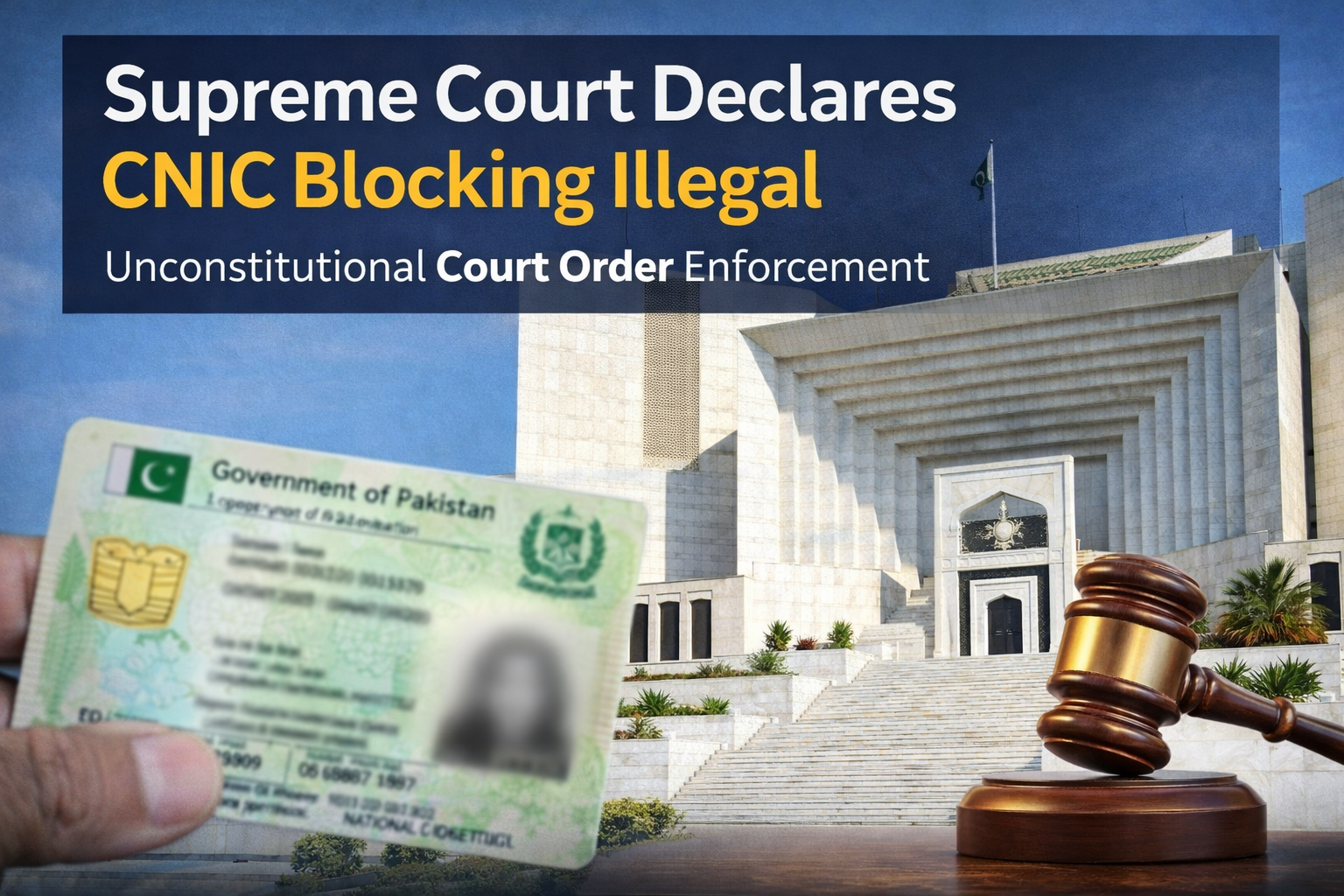
Is CNIC Blocking Legal in Pakistan? Supreme Court Constitutional Ruling Explained (2026 Update)
A CNIC is central to everyday legal and administrative life in Pakistan. It is used for identity verification and a wide range of transactions and services, which is why any restriction on a person’s CNIC can have serious practical consequences. Is CNIC blocking legal in Pakistan? Understand the Supreme Court’s 2026 ruling, Section 18 NADRA Ordinance, civil court powers and legal remedies.
In February 2026, the Supreme Court of Pakistan considered whether an executing court could block a judgment debtor’s CNIC as a method of enforcing a money decree. In Agha Abid Majeed Khan v. Idrees Ahmed and another, the Supreme Court held that blocking the judgment debtor’s CNIC was not a lawful mode of execution of the money decree in the circumstances before it. The Court set aside the orders of the executing court and the Sindh High Court.
However, this ruling should not be misunderstood as meaning that every CNIC restriction in Pakistan is automatically illegal. The legal basis, authority, reason for the restriction and procedure followed by NADRA or another institution remain important.
This 2026 guide explains what the Supreme Court decided, how Section 51 of the Code of Civil Procedure relates to the case, what Section 18 of the NADRA Ordinance means, and what a person can consider doing if their CNIC has been blocked.
What Did the Supreme Court Decide About CNIC Blocking in 2026?
The case involved a judgment debtor whose CNIC had been ordered to be blocked during execution proceedings relating to a money decree.
The Supreme Court examined whether Section 51 of the Code of Civil Procedure, 1908 gave an executing court sufficient authority to use CNIC blocking as a method of enforcing that money decree.
The Court concluded that it did not.
The judgment emphasized that although courts have powers to enforce their decrees, those powers must remain connected to the statutory framework governing execution. The general language of Section 51(e) could not be stretched so far that an executing court could use CNIC blocking for a simple money decree.
The Supreme Court therefore converted the leave petition into an appeal, allowed the appeal and set aside the orders under challenge.
Why Was the Supreme Court Concerned About CNIC Blocking?
The Court treated the CNIC as much more than an ordinary administrative document.
In its reasoning, the Court recognized that a CNIC has become essential to normal life. It compared the proposed use of CNIC blocking as a debt-recovery mechanism to the extreme idea of restricting essential utilities such as electricity or water simply to force compliance with a money decree.
The central point was not that courts lack authority to enforce judgments.
Rather, the issue was whether the particular enforcement method had lawful statutory authority.
This distinction is important when understanding the 2026 ruling.
What Was the Case About?
The case was Agha Abid Majeed Khan v. Idrees Ahmed and another, C.P.L.A. No. 3744 of 2023.
The petitioner was a judgment debtor in a money decree arising from a summary suit. During execution proceedings, the executing court directed that his CNIC be blocked until he furnished surety for the decretal amount.
The Sindh High Court subsequently upheld the executing court’s approach.
The matter then reached the Supreme Court, where a two-member bench comprising Justice Munib Akhtar and Justice Irfan Saadat Khan considered whether CNIC blocking was legally available under Section 51 of the CPC.
The Supreme Court ultimately rejected the use of CNIC blocking as the execution mechanism in that case.
What Does Section 51 of the CPC Say?
Section 51 of the Code of Civil Procedure provides different methods through which a court may execute a decree.
The provision includes mechanisms such as:
- Delivery of property
- Attachment and sale of property
- Arrest and detention in certain circumstances
- Appointment of a receiver
- Other lawful modes connected with the relief granted
The Supreme Court considered whether the general language in Section 51(e) could be used to justify blocking a person’s CNIC for enforcement of a money decree.
The Court concluded that the general provision could not be expanded beyond its lawful limits merely because a court wanted a stronger enforcement mechanism.
This makes the statutory basis of the enforcement action an important part of any CNIC-related legal dispute.
Does the Supreme Court Ruling Mean All CNIC Blocking Is Illegal?
No.
This is one of the most important points to understand.
The Supreme Court decision dealt with a specific situation: blocking the CNIC of a judgment debtor as a method of executing a money decree under Section 51 CPC.
It does not automatically determine every situation in which a CNIC may be restricted.
CNIC-related restrictions can arise from different circumstances, including:
- Identity verification issues
- Citizenship or nationality disputes
- Suspected identity fraud
- Duplicate or multiple identity records
- Criminal proceedings
- Court orders
- NADRA verification matters
- Statutory proceedings under the NADRA framework
The legal analysis therefore depends on the reason for the restriction and the authority under which it was imposed.
What Is Section 18 of the NADRA Ordinance?
Section 18 of the National Database and Registration Authority Ordinance, 2000 is important in understanding NADRA’s statutory powers concerning identity cards.
The provision deals with circumstances involving cancellation, impounding or confiscation of cards and includes procedural requirements.
This is different from saying that NADRA has an unlimited power to block any CNIC whenever it considers it appropriate.
The legality of a particular restriction depends on the statutory authority being relied upon, the facts of the case and whether the prescribed procedure was followed.
Can NADRA Block or Impound a CNIC?
The answer depends on why the action was taken and under what legal authority.
NADRA’s powers concerning CNICs operate within the statutory framework governing the Authority and identity documents.
For example, where a CNIC restriction is connected to a verification issue, citizenship dispute or other statutory matter, the legal analysis can be different from a situation where a civil court simply orders CNIC blocking to secure payment of a money decree.
Therefore, anyone facing a blocked CNIC should obtain the actual reason and legal basis for the restriction instead of assuming that the February 2026 Supreme Court decision automatically resolves the matter.
What Happens When a CNIC Is Blocked?
The practical consequences depend on the type of restriction.
A blocked or restricted identity record can create difficulties with matters that require identity verification.
Potential problems may involve:
- Banking and financial transactions
- SIM-related verification
- Property transactions
- Government services
- Employment-related verification
- Travel or identity documentation
- Other services requiring valid identity records
The exact consequences vary according to the nature of the restriction and the institution involved.
What Should You Do If Your CNIC Is Blocked?
The first step should be identifying the legal and administrative reason for the restriction.
1. Find Out Why the CNIC Was Blocked
Ask the relevant authority for the reason and legal basis.
If the restriction resulted from a court order, obtain a copy of that order.
2. Identify the Authority Behind the Restriction
Determine whether the restriction was:
- Directly imposed by NADRA
- Implemented by NADRA pursuant to a court order
- Connected to a criminal proceeding
- Related to identity verification
- Connected to another statutory process
This distinction can affect the available legal remedy.
3. Collect the Relevant Documents
Keep copies of:
- CNIC or identity documents
- NADRA notices
- Court orders
- Previous correspondence
- Verification documents
- Relevant case papers
A lawyer reviewing a CNIC dispute will generally need these documents to understand the legal basis of the restriction.
4. Consider the Appropriate Legal Remedy
Depending on the circumstances, the available options may include representation before the relevant authority, a statutory review process, approaching the concerned court, or constitutional proceedings where legally appropriate.
The correct remedy cannot be determined solely from the fact that a CNIC is blocked.
What If a Civil Court Ordered the CNIC Blocking?
This is where the 2026 Supreme Court ruling becomes particularly relevant.
If the CNIC was blocked solely as a method of enforcing a money decree, the Supreme Court’s decision provides important guidance on the limits of an executing court’s power under Section 51 CPC.
However, the exact court order still needs to be examined.
The question may include:
- What type of decree was passed?
- Which court issued the order?
- What statutory provision was relied upon?
- Was the CNIC blocking ordered as a coercive measure?
- Is there another legal basis for the restriction?
- Has a subsequent order been passed?
A later Sindh High Court decision in July 2026 illustrates why case-specific analysis remains important. In that matter, the court noted that where a CNIC had been blocked pursuant to a competent court’s order, NADRA did not have independent authority to remove the restriction without a subsequent order from the concerned court. The petitioner was directed to approach the court that had passed the relevant order.
This demonstrates that the practical procedure after a Supreme Court judgment may depend on the order and circumstances of the individual case.
What Did the Lahore High Court Say in 2026?
The 2026 Lahore High Court ruling is also relevant to the broader discussion.
In a case concerning CNIC blocking during civil proceedings, the Lahore High Court considered whether a CNIC could be treated as movable property and attached or impounded as a coercive measure.
The court held that a CNIC could not be treated as movable property of its holder for that purpose and discussed the statutory framework governing NADRA’s authority.
Together, these 2026 decisions show that courts have been examining CNIC restrictions through the questions of statutory authority, jurisdiction and lawful procedure.
CNIC Blocking and Constitutional Rights
A CNIC restriction can have consequences beyond the physical identity card itself because modern life involves extensive identity verification.
This is why constitutional considerations can arise when a government authority or court restricts access to identity documentation.
Relevant constitutional principles may include:
- Protection of life and liberty under Article 9
- Dignity under Article 14
- Due process and fair trial principles under Article 10-A
- Protection against unlawful or arbitrary exercise of public power
However, whether a particular CNIC restriction violates a constitutional right must be determined from the facts and applicable law.
A court does not decide every CNIC dispute solely on the existence of a constitutional right; it also examines the statutory authority, procedure and circumstances behind the restriction.
CNIC Blocking Cases in Islamabad and Rawalpindi
For residents of Islamabad and Rawalpindi, CNIC disputes can involve NADRA offices, civil courts, criminal proceedings or constitutional jurisdiction.
Where a CNIC issue has become a legal dispute, the relevant documents should be reviewed before deciding whether to approach NADRA, the court that issued an order, a High Court or another competent forum.
Legal Point – Advocates & Consultants can assist clients in reviewing CNIC-related disputes, court orders and available legal remedies in Islamabad, Rawalpindi and other parts of Pakistan.
Related Legal Point Guides
If you are researching CNIC blocking or NADRA-related legal issues, these related Legal Point articles may also help:
- CNIC Blocked by NADRA – What to Do? Complete Step-by-Step Guide
- CNIC Unblock After Supreme Court Decision – Legal Process & Complete Guide
- Can a Civil Court Block a CNIC in Pakistan? What the 2026 LHC Ruling Means
- NADRA CNIC Cases in Courts: Bail, Forgery, and Citizenship Rights in Pakistan
- NADRA Update 2026: Latest CNIC Rules, Fees and Online Solutions
These internal links create a useful topical cluster around CNIC blocking, NADRA disputes, Supreme Court case law and legal remedies. Legal Point’s website currently contains multiple related CNIC and NADRA guides, making this topic suitable for internal topical linking.
Frequently Asked Questions
Is CNIC blocking legal in Pakistan in 2026?
There is no single answer for every case. The Supreme Court held that blocking a judgment debtor’s CNIC as a mode of executing a money decree was not lawful under Section 51 CPC in the case before it. Other CNIC restrictions can involve different laws, authorities and facts.
Can a civil court block a CNIC for recovery of money?
The Supreme Court’s February 2026 ruling held that an executing court could not use CNIC blocking as a mode of execution of the money decree in the case before it.
Can NADRA restrict a CNIC?
NADRA has statutory powers concerning identity cards, but those powers must be exercised under the applicable legal framework and procedure. The reason and legal basis for the particular restriction are therefore important.
Does the Supreme Court ruling automatically unblock a CNIC?
No. A person should examine the order or administrative action that caused the restriction and determine what procedure is required in that particular case.
What should I do if my CNIC is blocked by NADRA?
First determine the reason and legal basis for the restriction. Obtain relevant notices or orders, collect your documents and seek appropriate legal advice about the available administrative or judicial remedy.
Can I file a constitutional petition against CNIC blocking?
A constitutional petition may be available in appropriate circumstances, but its suitability depends on the facts, the authority involved and any alternative statutory remedy.
Legal Assistance for CNIC Blocking and NADRA Disputes
CNIC restrictions can affect important areas of everyday life, but the legal remedy depends on the reason behind the restriction.
If your CNIC has been blocked by NADRA, restricted following a court order, or affected by a civil or criminal proceeding, Legal Point – Advocates & Consultants can review the relevant documents and explain the applicable legal options.
For legal assistance with CNIC blocking, NADRA disputes, constitutional petitions and related court matters in Islamabad, Rawalpindi and Pakistan, contact Legal Point for case-specific legal guidance.

