


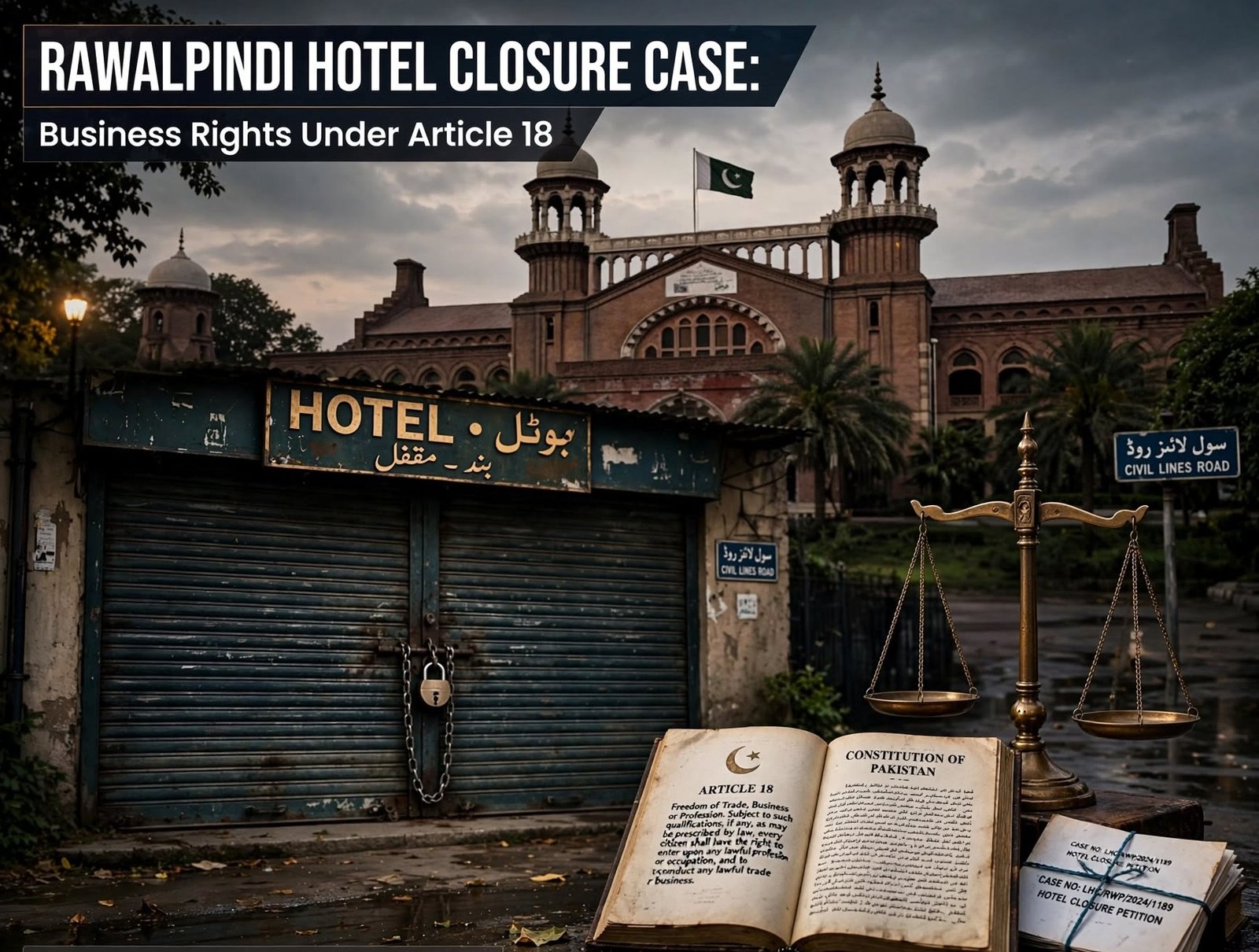
Rawalpindi Hotel Closure Case: Legal Rights of Businesses Under Article 18
The Rawalpindi hotel closure case has brought attention to an important legal question: what legal protections are available to business owners when their businesses are ordered to close during protests or law-and-order situations?
A hotel owner, Ahtisham ul Haq, has approached the Lahore High Court Rawalpindi Bench through Advocate Nazakat Hussain Abbasi, challenging what the petition describes as verbal directions from the district administration and police to close the hotel. According to the reports of the proceedings, the petitioner stated that hotels had been closed more than 20 times during the year and that the latest closure was ordered for an indefinite period.
The case also raises the broader issue of the constitutional right to conduct a lawful business in Pakistan, particularly in light of Article 18 of the Constitution.
What Is the Rawalpindi Hotel Closure Case About?
The petition concerns the closure of hotel businesses in Rawalpindi in the context of protests and law-and-order concerns.
According to the petitioner, the police and district administration had repeatedly closed hotels, with more than 20 closures alleged over the course of a year. The petitioner further claimed that the latest closure was to continue indefinitely.
The petitioner argued that repeated shutdowns were creating serious financial difficulties for hotel operators. Among the concerns raised were the ability to pay:
- Employees’ salaries
- Building rent
- Utility bills
- Other operating expenses
The petition therefore challenges the effect of repeated business closures and seeks judicial intervention regarding the actions attributed to the administration and police.
Who Filed the Petition?
The case was brought by hotel owner Ahtisham ul Haq, represented by Advocate Nazakat Hussain Abbasi.
The reports identify several government and law-enforcement officials as respondents, including the Chief Secretary Punjab, Home Secretary, Deputy Commissioner Rawalpindi and CPO Rawalpindi. SP Rawal and the SHO of Pir Wadhai were also made parties to the proceedings.
The legal challenge is therefore directed toward the administrative and police measures that the petitioner says resulted in the closure of the hotel business.
Why Is Article 18 Important in This Case?
One of the central constitutional provisions relevant to the issue is Article 18 of the Constitution of Pakistan, which deals with the freedom of trade, business or profession.
Article 18 provides that, subject to qualifications prescribed by law, every citizen has the right to enter a lawful profession or occupation and to conduct a lawful trade or business. The Constitution also recognises that trade and professions can be regulated through legal mechanisms, including licensing and regulation in specified circumstances.
This means that the right to conduct a business is constitutionally recognised, but it is not an unlimited right free from lawful regulation.
That distinction is particularly important in cases involving public order, licensing, safety requirements or other statutory powers. Whether a particular closure is lawful depends on the applicable law, the authority exercising the power, the circumstances and the facts placed before the court.
Can Authorities Close a Business During a Law-and-Order Situation?
Authorities may have legal powers to take measures concerning public safety and order, but the existence and scope of those powers depend on the relevant legal framework.
A business owner challenging a closure may therefore need to examine questions such as:
- What legal provision was relied upon for the closure?
- Which authority issued the direction?
- Was a written order issued?
- Was the business given any notice?
- What was the stated reason for the closure?
- How long was the closure intended to continue?
- Was the action based on a specific law or administrative direction?
- Were the relevant legal procedures followed?
These questions can become particularly significant where a business owner alleges that the closure was communicated through verbal directions rather than a formal written order.
The court, rather than the parties themselves, ultimately determines the legal validity of the challenged action based on the pleadings, evidence and applicable law.
What Did the Hotel Owner Ask the Court to Do?
According to the reported petition, the petitioner asked the Lahore High Court Rawalpindi Bench to restrain the administration and police from allegedly harassing or interfering with the business without lawful justification.
The petitioner also sought directions for the immediate reopening of the hotels.
These requests form part of the relief sought in the constitutional proceedings. They should not be understood as a final determination by the court unless and until the court issues an order deciding the relevant issues.
How Repeated Business Closures Can Affect Hotel Owners
Hotels operate through a combination of employees, rented or owned premises, utility services, suppliers and customers. Even a temporary closure can therefore have consequences for daily operations.
According to the petitioner’s position reported in the case, repeated closures had made it difficult to meet routine financial obligations, including employee salaries, rent and utility bills.
For hotel owners and other businesses, the legal issue can therefore extend beyond the immediate loss of daily revenue.
Repeated disruption may raise questions concerning:
- Contractual obligations
- Employee payments
- Commercial leases
- Supplier commitments
- Utility expenses
- Customer bookings
- Business reputation
- Financial losses
The exact legal remedy available in any particular situation depends on the facts, documents and applicable law.
What Should a Business Owner Do If Authorities Order Closure?
A business owner facing an administrative or police closure should avoid relying solely on verbal communications.
Where possible, the business should seek to establish a clear documentary record of the action.
Important records may include:
- Any written closure order or notice.
- Names and designations of officials involved.
- Date and time of the closure.
- Stated reason for the action.
- Any correspondence with the administration or police.
- Business registration and licensing documents.
- Evidence of financial losses where relevant.
- Employment and rental obligations.
- Previous closure notices or orders.
- Any communications requesting reopening.
These documents can help a lawyer understand the factual and legal basis of the dispute.
Legal Remedy Against Unlawful Business Closure
Where a business owner believes that an administrative action is unlawful, arbitrary or beyond the authority granted by law, legal advice should be obtained before selecting an appropriate remedy.
Depending on the circumstances, a matter may involve administrative representations, statutory remedies or constitutional proceedings before a competent court.
A constitutional petition can raise questions concerning the legality of government action and the protection of constitutional or legal rights. However, whether such a petition is maintainable and what relief may be available depends on the specific facts and applicable legal provisions.
The Rawalpindi hotel closure case illustrates why the legal basis of a closure can be important when a business owner challenges administrative action.
Court Proceedings in the Rawalpindi Hotel Closure Matter
The reported proceedings show that the case is currently part of ongoing litigation rather than a concluded judgment.
The available reports confirm that the hotel owner challenged the closure before the Lahore High Court Rawalpindi Bench and sought protection against the alleged administrative and police interference.
A separate report provided for this case states that the court sought a complete report from the relevant Punjab authorities and that Justice Tariq Mehmood Bajwa made a reported observation concerning reopening the hotels at the next hearing.
Because the matter is ongoing, subsequent court orders may clarify the legal position, the authorities’ response and any directions concerning reopening.
What Does Article 18 Mean for Businesses in Pakistan?
Article 18 provides an important constitutional framework for lawful trade, business and profession. However, it should not be interpreted as preventing every form of government regulation.
The Constitution itself recognises certain forms of regulation, including licensing systems and regulation of trade, commerce or industry in the interest of free competition.
Therefore, when a business is closed by a government authority, the key legal question is not simply whether the owner has a right to conduct business. The circumstances may also require examination of the legal authority, procedure, justification and duration of the closure.
This distinction is especially relevant to hotel owners and other businesses operating in areas affected by public-order measures.
Legal Representation by Legal Point
The Rawalpindi hotel closure matter has highlighted the importance of legal representation when a business owner challenges administrative action.
According to the case material provided and current reporting, Advocate Nazakat Hussain Abbasi represented hotel owner Ahtisham ul Haq in the Lahore High Court Rawalpindi Bench.
Legal Point — Advocates & Consultants provides legal guidance and representation in matters involving constitutional rights, business disputes, civil litigation and other legal issues.
For business owners facing government notices, administrative restrictions, closure directions or disputes concerning lawful business operations, obtaining case-specific legal advice can help identify the appropriate legal route.
Conclusion
The Rawalpindi hotel closure case raises an important legal issue concerning the relationship between public-order measures and the rights of businesses operating lawfully.
The petitioner’s position is that repeated hotel closures have caused substantial commercial difficulties and that the actions of the administration and police require judicial scrutiny. The constitutional discussion also brings Article 18 of the Constitution of Pakistan into focus, while recognising that lawful businesses remain subject to regulations prescribed by law.
As the proceedings continue, the court’s orders and the response of the concerned authorities will be important in determining how the specific dispute develops.
For hotel owners, traders and other business operators facing closure or administrative restrictions, the circumstances of each case should be examined individually, including the legal authority behind the action, documentation issued by officials and available legal remedies.
Need Legal Assistance With a Business Closure or Constitutional Matter?
If your business has been closed, restricted or affected by administrative or police action and you need professional legal guidance, contact Legal Point — Advocates & Consultants.
Call: +92 333 7703712
Email: legalpointteam@gmail.com
Know Your Legal Right, Live with Legal Point.
Frequently Asked Questions
Can a hotel owner challenge an administrative closure in Pakistan?
A business owner may have legal remedies depending on the nature and legal basis of the closure. The appropriate remedy depends on the specific facts, applicable law and authority involved.
What does Article 18 of the Constitution protect?
Article 18 recognises the right of citizens to enter a lawful profession or occupation and conduct a lawful trade or business, subject to qualifications and regulations prescribed by law.
Can authorities regulate or restrict a business?
Yes. Article 18 itself recognises that certain trades and professions may be regulated by law, including through licensing and other forms of regulation specified in the Constitution.
What should I do if police or administration verbally order my business to close?
A business owner should seek clarification of the legal basis of the order and, where possible, obtain written documentation. Legal advice should be sought promptly if the owner believes the action is unlawful.
Is the Rawalpindi hotel closure case finally decided?
Based on the reports available as of September 22, 2026, the matter is ongoing. The reported petition seeks relief concerning the hotel closures; it should not be treated as a final judicial determination of the underlying dispute.

