


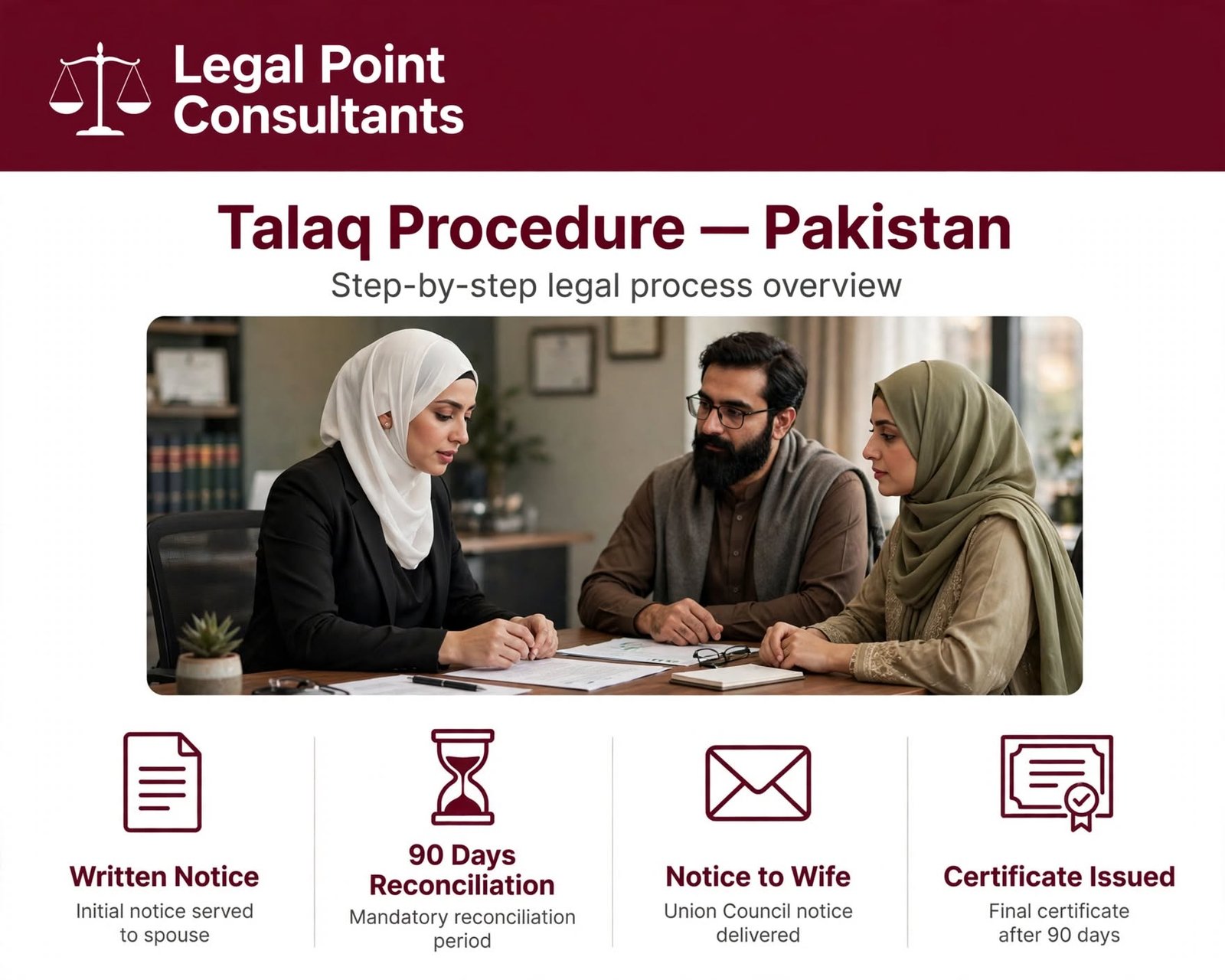
Talaq Procedure in Pakistan: Basic Legal Information
Understanding the Talaq Procedure in Pakistan is important for anyone considering divorce because simply pronouncing Talaq does not remove the need to follow the legal procedure prescribed under Pakistani family law. Section 7 of the Muslim Family Laws Ordinance, 1961 (MFLO) requires a husband who pronounces Talaq to give written notice to the Chairman concerned and provide a copy of that notice to his wife. The law also provides a 90-day period after delivery of the notice during which reconciliation may be attempted.
Divorce is a sensitive family matter and can involve issues such as maintenance, children, dower, residence, property and future legal documentation. Therefore, understanding the basic procedure before taking action can help avoid unnecessary procedural mistakes.
This guide explains the general legal process in simple terms. It is intended for general legal information and should not be treated as a substitute for advice based on the specific facts of a case.
What Is Talaq Under Pakistani Law?
Talaq generally refers to divorce initiated by the husband under Muslim personal law.
In Pakistan, however, the legal consequences of Talaq are connected with the statutory procedure under the Muslim Family Laws Ordinance, 1961. Section 7 specifically deals with Talaq and requires written notification to the Chairman after the pronouncement.
This means that a person should not assume that saying Talaq verbally automatically completes every legal formality required by the state.
The legal process involves:
- Pronouncement of Talaq
- Written notice
- Notice to the wife
- Union Council involvement
- Reconciliation efforts
- Statutory 90-day period
- Completion of divorce formalities
- Obtaining appropriate documentary proof
The exact circumstances can affect the procedure, particularly where there are children, disputes over maintenance, delegated divorce rights, overseas residence or ongoing court proceedings.
What Is the Basic Talaq Procedure in Pakistan?
The general procedure can be understood through the following steps.
Step 1: Pronouncement of Talaq
The process begins with the husband pronouncing Talaq.
However, the pronouncement itself should not be treated as the end of the legal process. Section 7 of the MFLO places a statutory notification requirement on the husband after Talaq is pronounced.
Because family-law consequences can be significant, it is advisable to understand the legal consequences before making a final decision.
Step 2: Prepare the Written Talaq Notice
After pronouncing Talaq, the husband must give written notice to the relevant Chairman.
The notice is commonly prepared as a Talaqnama or divorce notice, depending on the circumstances and local practice.
The document should contain accurate information regarding the spouses and marriage and should be prepared carefully.
Errors in names, CNIC information, addresses or marriage details can create unnecessary administrative problems later.
Step 3: Send the Notice to the Chairman
Under Section 7(1), the husband must give notice in writing to the Chairman and supply a copy of that notice to the wife.
The relevant Union Council depends on the applicable jurisdiction and circumstances.
The West Pakistan Rules under the Muslim Family Laws Ordinance also contain provisions dealing with the appropriate Union Council and situations where the wife’s whereabouts are unknown.
This is one reason why selecting the correct Union Council is important.
Step 4: Wife Receives a Copy of the Notice
The law requires the wife to receive a copy of the Talaq notice.
If there is an issue regarding her whereabouts or service of notice, special procedural rules may become relevant. The applicable rules provide mechanisms for certain circumstances where the wife’s whereabouts cannot be ascertained.
A person should therefore not simply assume that sending a document to an incorrect address will satisfy every legal requirement.
Step 5: Arbitration Council and Reconciliation
Once the Chairman receives the Talaq notice, the law provides for the constitution of an Arbitration Council.
Section 7(4) states that the Arbitration Council is constituted within 30 days of receipt of the notice for the purpose of attempting reconciliation between the parties.
The objective is to give the spouses an opportunity to resolve the dispute and potentially restore the marriage before the Talaq becomes effective.
The process may involve notices, meetings and participation by representatives or family members according to the applicable procedure.
What Is the 90-Day Talaq Period?
The 90-day period is one of the most important parts of the Talaq Procedure in Pakistan.
Under Section 7(3) of the MFLO, Talaq does not become effective until the expiration of 90 days from the day on which the notice is delivered to the Chairman, unless it is revoked earlier.
This means the calculation is connected to the statutory notice delivered to the Chairman, rather than simply counting 90 days from the day someone verbally mentions Talaq.
The period serves an important reconciliation function.
Can Talaq Be Revoked During the 90 Days?
The law expressly provides that Talaq may be revoked before it becomes effective. Section 7 states that Talaq, unless revoked earlier, becomes effective after the statutory period.
If the parties reconcile, the legal position should be properly documented so that there is no uncertainty about their marital status or future records.
What Happens After 90 Days?
If the Talaq has not been revoked and the statutory requirements have been completed, the Talaq becomes effective according to the applicable law.
The parties should then ensure that the relevant administrative and documentary formalities are completed and that appropriate proof of dissolution is obtained.
A divorce certificate or other official record can become important for:
- NADRA records
- Future marriage
- Immigration matters
- Visa applications
- Family records
- Legal proceedings
- Overseas documentation
The exact document issued and the administrative process can vary depending on the relevant authority and jurisdiction.
Is a Divorce Certificate Important?
Yes. Proper documentary evidence of divorce is extremely important.
A person may later need proof of marital status for government records, immigration, marriage registration, inheritance-related matters or other legal purposes.
Therefore, after completion of the Talaq process, the parties should preserve:
- Talaq notice
- Proof of service
- Union Council documents
- Arbitration Council records where applicable
- Divorce certificate
- Marriage documents
- CNIC copies
- Any relevant court orders
Keeping a complete record can make future legal or administrative procedures considerably easier.
Documents Commonly Needed for Talaq
The exact requirements can vary according to the relevant Union Council and individual circumstances, but documents may commonly include:
- CNIC copy of the husband
- CNIC copy of the wife
- Nikahnama
- Marriage registration details
- Current addresses of both parties
- Written Talaq notice/Talaqnama
- Contact details
- Relevant supporting documents
- Authority documents where someone is acting through an authorized representative
Additional documents may be necessary in cases involving overseas Pakistanis, missing spouses, court proceedings or disputes concerning children and maintenance.
Before submitting documents, it is sensible to verify the requirements of the relevant local authority.
Talaq vs Khula: What Is the Difference?
Talaq and Khula are not identical procedures.
Generally, Talaq is initiated by the husband, whereas Khula is a judicial process through which a wife seeks dissolution of marriage.
Legal Point already has a detailed guide on the Documents Required for Khula in Pakistan and related family-law material that can help readers understand the alternative route when the wife is seeking dissolution.
The distinction is important because the procedure, documents and court involvement may differ.
For a broader understanding of divorce and family-law options, readers can also review Legal Point’s existing Best Divorce Lawyer in Islamabad | Family Lawyers & Law Firms guide, which covers Talaq, Khula, custody, maintenance and Family Court matters.
What About Children After Talaq?
Divorce does not automatically resolve questions concerning children.
Parents may need to address:
- Child custody
- Guardianship
- Visitation
- Maintenance
- Education
- Healthcare
- Residence
Courts consider the welfare and circumstances of the child when dealing with custody and guardianship issues.
Legal Point has already published a dedicated guide on Child Custody Laws in Pakistan, which provides further information about custody and the welfare-of-the-child principle.
Where children are involved, it is important to treat the divorce process and child-related issues as connected but legally distinct matters.
What About Maintenance and Dower?
Divorce may also raise financial questions.
Depending on the facts, these may include:
- Unpaid dower (Haq Mehr)
- Maintenance claims
- Children’s financial support
- Property-related disputes
- Other contractual or legal rights
The financial consequences of divorce can vary significantly from one case to another. A person should therefore avoid assuming that every divorce automatically produces the same financial outcome.
Relevant documents such as the Nikahnama, financial records and previous agreements may become important.
What If the Husband Lives Outside Pakistan?
Overseas Pakistanis may face additional documentation and representation issues.
For example, a husband living abroad may need to consider:
- How the Talaq notice will be prepared
- How documents will be signed
- Whether an authorized representative is required
- Which Union Council has jurisdiction
- How documents will be served
- How the divorce will be recorded
- How the resulting documents will be used abroad
Because international documentation can involve additional requirements, overseas Pakistanis should obtain case-specific legal advice before submitting documents.
Legal Point also provides family-law guidance for Pakistanis dealing with legal matters involving Pakistan while living abroad.
Common Mistakes During Talaq Procedure
People often make procedural mistakes because they believe that pronouncing Talaq alone completes everything.
Common mistakes include:
1. Ignoring the Written Notice Requirement
Section 7 requires written notice to the Chairman after Talaq is pronounced.
2. Sending Notice to the Wrong Authority
The applicable Union Council and jurisdiction should be checked before submission.
3. Failing to Provide a Copy to the Wife
The law specifically requires a copy of the notice to be supplied to the wife.
4. Assuming Divorce Is Immediate
The statutory 90-day period is an important part of the legal process.
5. Ignoring Reconciliation Proceedings
The Arbitration Council process should not simply be ignored.
6. Losing Official Documents
Keep copies of all notices, receipts, correspondence and certificates.
7. Ignoring Child-Related Rights
Where children are involved, custody, guardianship and maintenance should be addressed separately.
How Long Does the Talaq Procedure Take?
The statutory framework provides a 90-day period from delivery of the notice to the Chairman, subject to the provisions of Section 7. The Arbitration Council is to be constituted within 30 days of receipt of the notice for reconciliation purposes.
However, the practical completion of documentation can depend on:
- Union Council procedures
- Service of notices
- Reconciliation proceedings
- Availability of the parties
- Documentation
- Jurisdiction
- Special circumstances
Therefore, it is better to distinguish between the statutory 90-day period and the time required for administrative completion of all documents.
When Should You Consult a Family Lawyer?
Professional legal advice can be particularly useful when:
- The marriage involves children
- Maintenance is disputed
- Dower is disputed
- The wife or husband lives overseas
- The wife’s whereabouts are unknown
- There are property disputes
- Court proceedings are already pending
- There is disagreement about the Talaq
- Documents contain errors
- You need advice regarding the appropriate Union Council
Legal Point’s existing Best Divorce Lawyer in Islamabad guide explains how family lawyers can assist with divorce, Khula, child custody, maintenance and related family matters.
Talaq Procedure in Pakistan: Quick Checklist
Before proceeding, a person should generally consider the following checklist:
- Understand the legal consequences of Talaq.
- Confirm the marriage and Nikahnama details.
- Pronounce Talaq where appropriate.
- Prepare the required written notice.
- Submit the notice to the appropriate Chairman/Union Council.
- Provide a copy of the notice to the wife.
- Participate in the reconciliation process where required.
- Observe the statutory 90-day period.
- Address child custody and maintenance issues where applicable.
- Obtain and preserve official divorce documentation.
The exact procedure should be confirmed according to the facts of the case and applicable local requirements.
Frequently Asked Questions
Is verbal Talaq enough to complete the legal process in Pakistan?
Verbal pronouncement does not remove the statutory notification requirements under Section 7 of the Muslim Family Laws Ordinance, 1961. Written notice to the Chairman and a copy to the wife are required under the law.
How many days does Talaq take in Pakistan?
Section 7 provides that Talaq does not become effective until 90 days have expired from delivery of the notice to the Chairman, unless revoked earlier. If the wife is pregnant, the Ordinance provides a special rule under which effectiveness is deferred until the later of the statutory period or the end of pregnancy.
Does the husband need his wife’s permission for Talaq?
The statutory Talaq procedure is initiated by the husband, but the legal process still requires compliance with Section 7, including written notice and the statutory reconciliation period.
What is a Talaqnama?
A Talaqnama generally refers to the written document or notice recording the Talaq. Its preparation should accurately reflect the relevant marriage and parties’ information.
What happens if the husband does not send notice to the Union Council?
Failure to comply with the written-notice requirement can create serious legal consequences. Section 7(2) provides a penalty for contravention of the notice requirement.
Can Talaq be revoked during the 90-day period?
Section 7 provides that Talaq remains ineffective until the expiry of the statutory period unless revoked earlier.
Is Talaq the same as Khula?
No. Talaq and Khula follow different legal routes. Talaq is generally initiated by the husband, while Khula involves a wife’s application for dissolution through the judicial process.
What happens to children after divorce?
Child custody, guardianship, visitation and maintenance are separate legal issues that may need to be addressed according to the child’s welfare and applicable family law. Legal Point’s child-custody guide provides further information on this subject.
Final Thoughts
The Talaq Procedure in Pakistan involves more than simply pronouncing divorce. Pakistani law requires written notice to the Chairman, a copy of the notice to the wife and a statutory reconciliation period before Talaq becomes effective. Section 7 of the Muslim Family Laws Ordinance, 1961 is therefore central to understanding the legal process.
If children, maintenance, dower, property, overseas residence or disputed documentation are involved, the matter can become more complicated. Getting appropriate legal guidance before taking action can help protect your rights and reduce avoidable procedural problems.
Legal Point Advocates & Consultants
Legal Point Advocates & Consultants provides legal assistance in family and matrimonial matters, including divorce, Khula, child custody, maintenance and related family disputes.
If you need advice about your particular circumstances, consult a qualified family lawyer who can review your documents and explain the applicable legal procedure.
Need legal guidance about Talaq, divorce or another family-law matter? Contact Legal Point Advocates & Consultants for professional legal consultation in Islamabad and Rawalpindi.

