


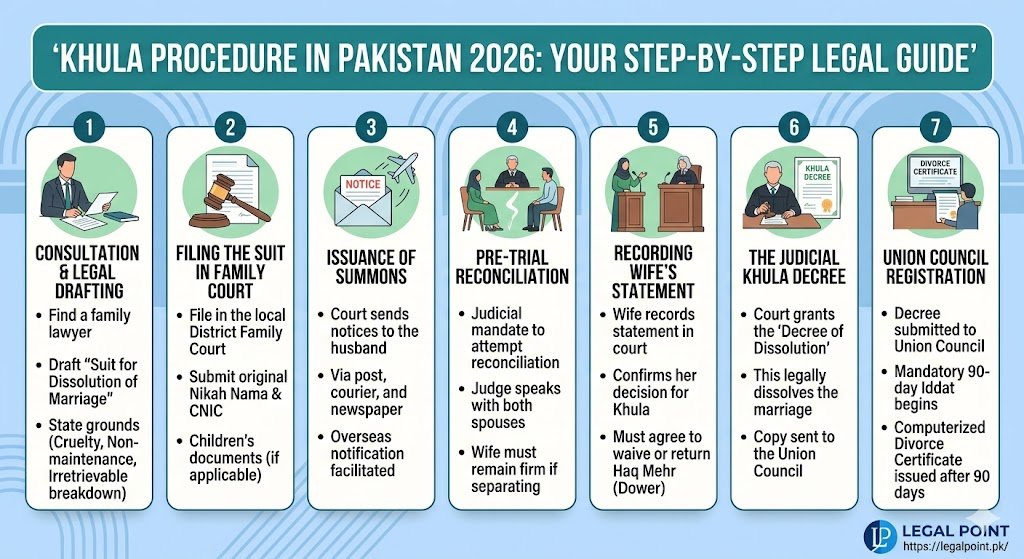
The legal landscape of Pakistan has evolved significantly to protect the rights of women within the framework of Islamic Jurisprudence and the Constitution. In 2026, the process of Khula—the right of a Muslim woman to seek a judicial divorce—has become more structured, utilizing digital legal portals and streamlined court procedures to ensure swift justice.
This article provides an in-depth exploration of the Khula procedure, the financial implications, and the administrative requirements for 2026.
Understanding Khula: The Legal Definition
In Pakistan, Khula is governed by the Dissolution of Muslim Marriages Act (1939) and the Muslim Family Laws Ordinance (1961). Unlike Talaq (where the husband initiates the divorce), Khula is a court-enforced dissolution initiated by the wife. It is based on the principle that if a woman can no longer live with her husband within “the limits prescribed by Allah,” she has the right to seek separation by returning certain financial benefits.
Phase 1: Pre-Filing and Legal Strategy
1. Identifying Grounds for Khula
While a woman can seek Khula simply by stating she has developed an “irretrievable hatred” for her husband, legal experts often advise including specific grounds to strengthen the case. These include:
- Non-maintenance: The husband has failed to provide financial support for over two years.
- Cruelty: Physical, emotional, or mental abuse.
- Desertion: The husband’s whereabouts have been unknown for four years.
- Imprisonment: The husband is sentenced to seven years or more.
- Incompatibility: A profound lack of harmony making a shared life impossible.
2. Documentation Requirements
Before approaching the court, ensure the following documents are in order:
- Original Nikah Nama: If lost, a certified copy must be obtained from the Union Council where the marriage was registered.
- Valid CNIC: The wife’s Computerized National Identity Card.
- Photographs and Evidence: Any evidence of cruelty or lack of maintenance (medical reports, text messages, or bank statements).
- Children’s Documents: B-Forms or birth certificates if custody is also being contested.
Phase 2: The Judicial Step-by-Step Process
Step 1: Filing the Suit (The Petition)
The wife, through her legal counsel, files a “Suit for Dissolution of Marriage” in the Family Court of the district where she currently resides or where the marriage took place. In 2026, many districts allow for the digital submission of initial pleadings through the e-Courts Pakistan portal.
Step 2: Issuance of Summons
Once the suit is admitted, the court issues notices to the husband. This is done via:
- Process Server: Physical delivery to his residence.
- Registered Post/Courier: Official legal notice.
- Digital Notification: Since 2024, courts increasingly accept WhatsApp or Email as valid “substituted service” if the husband is evading physical summons.
- Newspaper Publication: If his location is unknown.
Step 3: Submission of Written Statement
The husband is given a specific timeframe (usually 15 days) to file a written reply. If he fails to appear despite multiple notices, the court can proceed Ex-Parte, meaning the case continues in his absence.
Step 4: Pre-Trial Reconciliation (The Most Critical Step)
The Family Court Judge is legally mandated to attempt a “Reconciliation” (Sulah) between the spouses.
- The Session: The judge talks to both parties (usually in chambers) to see if the marriage can be saved.
- The Outcome: If the wife states categorically that she cannot live with the husband under any circumstances, the reconciliation is declared “failed.”
Step 5: The Recording of Evidence
In cases of Khula, the wife’s testimony is the primary evidence. She must record a statement before the judge stating her desire for a divorce. In 2026, for women living abroad or those with safety concerns, testimony can be recorded via secure video link.
Step 6: The Decree of Khula
After the evidence is recorded, the Judge passes a Decree of Dissolution of Marriage. The court will also order the wife to return her Haq Mehr (dower) or waive any unpaid dower as a condition for the Khula.
Phase 3: Post-Decree Administrative Requirements
The court decree alone does not finalize the divorce for NADRA purposes. You must follow the Union Council procedure.
- Notice to Union Council: The wife must submit a certified copy of the court decree to the Union Council in the area where the Nikah was registered.
- The 90-Day Iddat Period: Upon receipt, the Union Council issues a notice to the husband. This starts the 90-day mandatory period.
- Arbitration Council: The Union Council may attempt another reconciliation during this time.
- Divorce Certificate: After 90 days, if no reconciliation occurs, the Union Council issues the Computerized Divorce Certificate. This document is essential for updating NADRA records and for remarriage.
Financial Implications: What Must be Returned?
The concept of Khula involves “compensation.”
- Haq Mehr: The wife must generally return the Muajjal (Prompt) dower she received at the time of marriage. If it was never paid to her, she must waive her right to claim it.
- Jahez (Dowry): The wife is the absolute owner of her dowry articles (furniture, clothes, jewelry given by her parents). The court will usually grant her a separate decree to recover these items.
- Gifts: Purely personal gifts given by the husband may sometimes be asked to be returned, but this is subject to the judge’s discretion based on the circumstances.
Khula for Overseas Pakistanis in 2026
The 2026 legal framework has made it significantly easier for women residing in the UK, USA, UAE, or elsewhere to obtain a Khula without traveling to Pakistan.
- Power of Attorney: The woman can execute a “Special Power of Attorney” (SPA) attested by the Pakistani Consulate.
- Online Appearance: Courts now prioritize virtual hearings for overseas litigants to save time and travel costs.
- Direct UC Registration: Digital integration allows Union Councils to verify court decrees through centralized databases.
FAQ: Frequently Asked Questions
Q1: Is the husband’s signature required for Khula? No. Khula is granted by the court. If the judge is satisfied that the marriage has broken down, the decree is issued regardless of the husband’s consent.
Q2: Can I get Khula if my husband is abusive? Yes. In fact, if cruelty is proven, the judge may waive the requirement for you to return the Haq Mehr.
Q3: What happens to the custody of the children? Khula and Child Custody are handled in the same Family Court but are different legal issues. The mother usually keeps custody (Hizanat) of minors (sons until age 7, daughters until puberty), provided she meets the criteria for the child’s welfare.
Q4: Can I remarry after getting the court decree? Only after the 90-day Iddat period is complete and the Union Council Divorce Certificate is issued. Remarrying before this is legally problematic and can lead to charges of bigamy.
Q5: How much does a Khula cost in 2026? Court fees are nominal. However, lawyer fees vary based on the complexity of the case (e.g., if custody or recovery of dowry is involved). Most cases range between PKR 50,000 to PKR 150,000.
Q6: What is the difference between Khula and Judicial Divorce? Technically, Khula is a form of judicial divorce. The term “Judicial Divorce” is broader and covers cases where the wife seeks dissolution based on specific faults (like the husband’s disappearance) without necessarily returning the dower.
Conclusion
The Khula procedure in Pakistan is designed to provide a legal exit for women in distressed marriages. While the process involves several judicial and administrative steps, the 2026 updates have focused on reducing the “delay tactics” often used by defendants. By understanding your rights, preparing the necessary documentation, and following the Union Council registration, the transition can be handled with dignity and legal security.

