


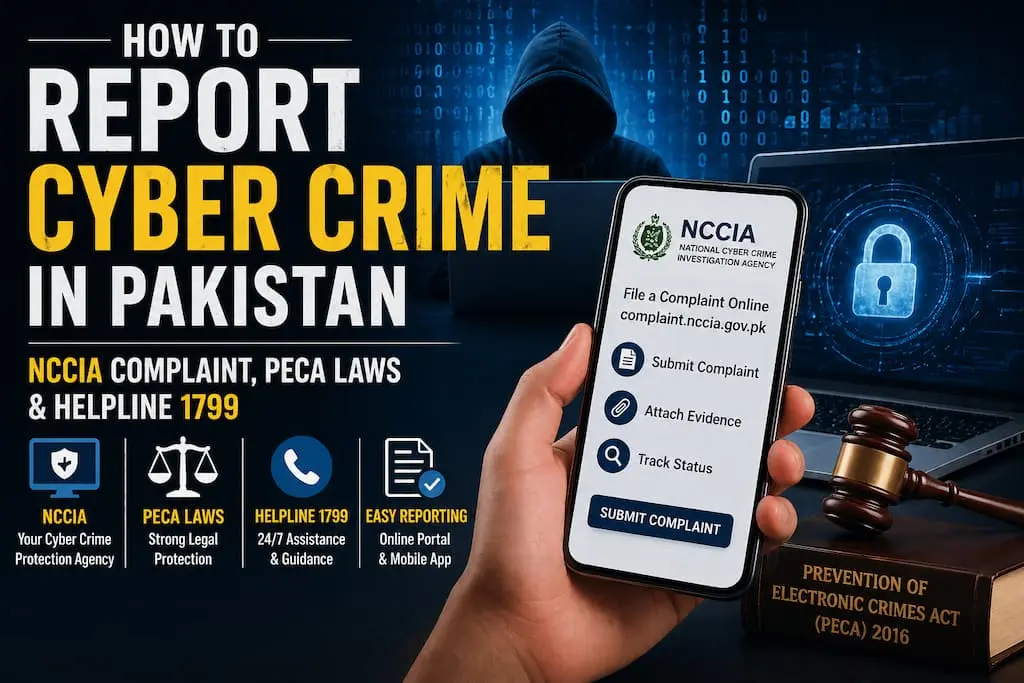
In today’s digital world, cyber threats such as online fraud, cyber harassment, identity theft, SIM fraud, and social media blackmail are rising rapidly across Pakistan. To combat these growing risks, the government has strengthened cyber laws under the Prevention of Electronic Crimes Act (PECA) and introduced the National Cyber Crime Investigation Agency (NCCIA) as the primary authority for handling digital crimes. Whether you need to file a cyber crime complaint in Pakistan, report online fraud, or seek legal protection against harassment, understanding the correct reporting process and your legal rights is essential.
If you are facing online fraud, cyber harassment, or digital blackmail, speaking with an experienced cyber crime lawyer in Pakistan can improve your chances of faster action and successful legal protection.
1. What is NCCIA? Pakistan’s New Cyber Crime Investigation Agency
For nearly two decades, the Federal Investigation Agency (FIA) served as the primary defender of Pakistan’s digital borders through its Cyber Crime Wing (CCW). However, the sophistication of modern threats—ranging from deepfakes to organized financial syndicates—demanded an evolution. In May 2024, the Government of Pakistan established the National Cyber Crime Investigation Agency (NCCIA), which became fully operational in April 2025.
For the citizen, this is not a mere name change. The NCCIA is a specialized, independent “body corporate” headed by a Director General with the exclusive powers of an Inspector General of Police. Per the amended Section 30 of PECA, the NCCIA now holds exclusive jurisdiction over cybercrime, meaning regular police or legacy FIA wings no longer handle these cases. This transition ensures a high-tech, centralized approach to digital forensics and prosecution.
Quick Facts: The NCCIA Operational Launch
- Operational Date: April 2025.
- Legal Mandate: Successor to FIA-CCW under the 2025 PECA Amendments.
- Authority: Exclusive power to investigate and prosecute digital offenses.
- Tech Advantage: Houses independent forensic labs for bit-for-bit data imaging.
Now that we understand who is protecting our digital borders, let’s look at the specific laws that define what constitutes a digital crime.
2. Cyber Crimes Covered Under PECA Law in Pakistan
The Prevention of Electronic Crimes Act (PECA) 2016 and its 2025 Amendments categorize offenses to ensure technical precision in the courtroom. As a consultant, I emphasize that “knowing the section” is the first step toward a successful legal filing.
| Crime Category (PECA Section) | Legal Definition | Citizen’s Example (The ‘So What?’) |
| Unauthorized Access (Section 3) | Gaining access to any computer system or data without legal authorization. | The Risk: Someone hacking your social media or office cloud. Legal Shield: You are not liable for actions taken by the hacker while they hold control. |
| Financial Fraud (Section 13) | Engaging in fraudulent acts for financial gain through electronic means. | The Risk: “Fake investment” WhatsApp scams or OTP theft. Legal Shield: Enables the legal freezing of fraudulent bank or mobile wallet accounts. |
| Identity Theft (Section 16) | Unauthorized registration of SIMs or social media accounts in another’s name. | The Risk: Discovering a SIM registered to your CNIC without your knowledge. Legal Shield: Exonerates you from crimes committed using that fraudulent identity. |
| Cyber Harassment (Section 20) | Defamation, blackmail, or threats communicated via digital channels. | The Risk: Sharing morphed images or private data to coerce an individual. Legal Shield: Provides a mandate for immediate content removal and criminal arrest. |
| Cyberstalking (Section 24) | Persistent unwanted communication or monitoring of an individual’s digital life. | The Risk: An ex-partner or stranger repeatedly following your digital trail to cause fear. Legal Shield: Restrains the perpetrator and creates a digital “no-contact” order. |
| False Information (Section 26-A) | Intentional dissemination of false and fake information to cause public unrest. | The Risk: Spreading viral disinformation targeting individuals or institutions. Legal Shield: Protects the public from “fake news” that incites violence or harm. |
Identifying a crime is the first step; knowing how to document it ensures that your complaint leads to actual justice.
3. PECA 2025 Amendments and Social Media Protection Laws
The 2025 Amendments introduced a specialized regulatory and adjudication layer designed to manage the speed of the social media age. These changes focus heavily on “online safety” and the concept of “Aspersion”—the spreading of false/fake information intended to damage the reputation of individuals or state institutions.
- Social Media Protection and Regulatory Authority (SMPRA): A new body corporate authorized to “enlist” platforms and issue directions to block or remove unlawful content within 30 days.
- Social Media Complaint Council (SMCC): A five-member body established to receive public complaints regarding PECA violations. Notably, the 2025 update expands the definition of “Complainant” to include “non-victims,” enabling concerned citizens to report crimes they witness, even if they are not the primary target.
- Social Media Protection Tribunals (SMPTs): Specialized courts consisting of three members: one legal expert, one journalistic expert, and one IT expert. This ensures that cases are judged with both legal and technical context.
- Increased Penalties: Conviction for disseminating false information (Aspersion) now carries a penalty of up to 3 years imprisonment and/or a fine of up to 2 million PKR.
For real-time updates on the enactment and implementation of these rigorous new standards, citizens are encouraged to monitor reporting from major outlets such as Dawn News.
With these powerful new structures in place, here is exactly how you can use them to report an incident.
4. How to File an NCCIA Complaint Online
Pakistani citizens now have three primary channels to initiate a case. It is vital to understand that while a report starts the process, the law mandates a 14-day verification period before a formal investigation begins.
- Pathway A: Digital (Fastest)
- Online Portal: Submit your case via complaint.nccia.gov.pk.
- NCCIA Reporting App: Available on Google Play, the 2025 app uses AI-powered liveness checks and CNIC verification to prevent fraudulent filings.
- Email: You may also send detailed complaints to helpdesk@nccia.gov.pk.
- Pathway B: Telephonic (24/7)
- Helpline 1799: Dial the toll-free number 1799 for guidance. While a call does not constitute a formal FIR, it is the fastest way to receive instructions on securing your compromised accounts.
- Pathway C: Physical (Formalization)
- Cyber Crime Reporting Centre (CCRC): For cases involving significant financial loss or the need for device forensics, an in-person visit is mandatory to register a First Information Report (FIR).
While the reporting channels are accessible, the success of your case depends on the quality of evidence you provide.
5. Required Evidence for Cyber Crime Complaints (Checklist)
In the digital courtroom, simple screenshots are rarely sufficient. To withstand the scrutiny of an SMPT, evidence must maintain forensic integrity. This requires original, unedited files that allow for SHA-256 hashing to prove the data has not been tampered with.
Identity theft & SIM Fraud
- 668 SMS Verification: Screenshot the reply from 668 showing the total SIM count on your CNIC.
- 667 SMS Data: If you have the unauthorized SIM, send “MNP” to 667 to document registration metadata.
- Portal Verification: Date-stamped screenshots from
cnic.sims.pk.
Online Fraud & Financial Scams
- Transaction Metadata: The 12-digit Transaction ID (UTR) and the name of the bank/mobile wallet (JazzCash/Easypaisa).
- Soft Copies: Exported transaction logs (PDF or CSV) directly from your banking app.
- Phishing URLs: The full, un-shortened web address of the fraudulent site.
Cyber Harassment and Blackmail
- Full Context Screenshots: Uncropped images showing the perpetrator’s name/number and timestamps.
- Profile URLs: The direct link to the perpetrator’s profile (Essential for the NCCIA to subpoena platform data).
- Original Media: Unedited, original photos or videos received.
- Physical Copies: Printed versions of all digital evidence for in-person FIR registration.
Navigating these technicalities can be overwhelming, which is where professional legal intervention becomes a vital asset.
6. When to Hire a Cyber Crime Lawyer in Pakistan
While the NCCIA is designed for public access, specialized cyber-law consultants add defensive value that can make the difference between a dismissed complaint and a successful conviction.
A specialized lawyer ensures your evidence meets “bit-for-bit” forensic standards and maintains a defensible Chain of Custody. While the law provides an investigation window of 90 days, a professionally drafted application—complete with authenticated metadata and clear legal framing—often satisfies the 14-day verification period immediately, significantly reducing delays. Legal representation is also critical for navigating the specialized Social Media Protection Tribunals.
Official Resources:
- NCCIA Official Portal: complaint.nccia.gov.pk
- Federal Investigation Agency: www.fia.gov.pk (Legacy references only)
By using these resources and staying vigilant, you contribute to a more secure and resilient digital Pakistan.
FAQ’s
1. How can I file a cyber crime complaint in Pakistan online?
To file a cyber crime complaint in Pakistan, visit the official NCCIA complaint portal at complaint.nccia.gov.pk and submit your application with screenshots, transaction details, or other digital evidence. The NCCIA reviews complaints within the legal verification period before initiating an investigation under the Prevention of Electronic Crimes Act (PECA). If your case involves serious financial fraud or blackmail, consulting a cyber crime lawyer can help ensure your complaint is legally strong.
2. What is the NCCIA helpline number for cyber harassment and online fraud?
The official NCCIA helpline number is 1799, available for guidance on issues like cyber harassment, online scams, identity theft, and social media blackmail. While calling 1799 does not register a formal FIR, it can help victims secure compromised accounts and understand the next legal steps. For urgent matters involving threats or extortion, legal assistance may speed up formal proceedings.
3. Can I report online fraud and bank scams under PECA law in Pakistan?
Yes, online fraud, phishing scams, OTP theft, and fake investment schemes are punishable under Section 13 of PECA. Victims should preserve transaction IDs, bank statements, and scam messages before filing a complaint with NCCIA. In high-value fraud cases, a cyber crime complaint lawyer in Pakistan can help pursue account freezing and legal recovery options.
4. Is cyber harassment or blackmail a punishable offense in Pakistan?
Yes, cyber harassment, online blackmail, defamation, and sharing private or morphed images are criminal offenses under Section 20 of PECA. Victims can file a complaint with NCCIA and request content removal or legal action against the offender. A lawyer specializing in cyber harassment cases can also assist in obtaining restraining orders or representation before tribunals.
5. When should I hire a cyber crime lawyer in Pakistan?
You should consider hiring a cyber crime lawyer in Pakistan when your case involves major financial loss, social media defamation, blackmail, SIM fraud, or complex evidence requiring legal presentation. A lawyer can draft a stronger cyber crime complaint in Pakistan, maintain the chain of custody of digital evidence, and represent you before the Social Media Protection Tribunals or other courts.

