


Published: June 2025 | Updated: May 2026 | By Javed Khan
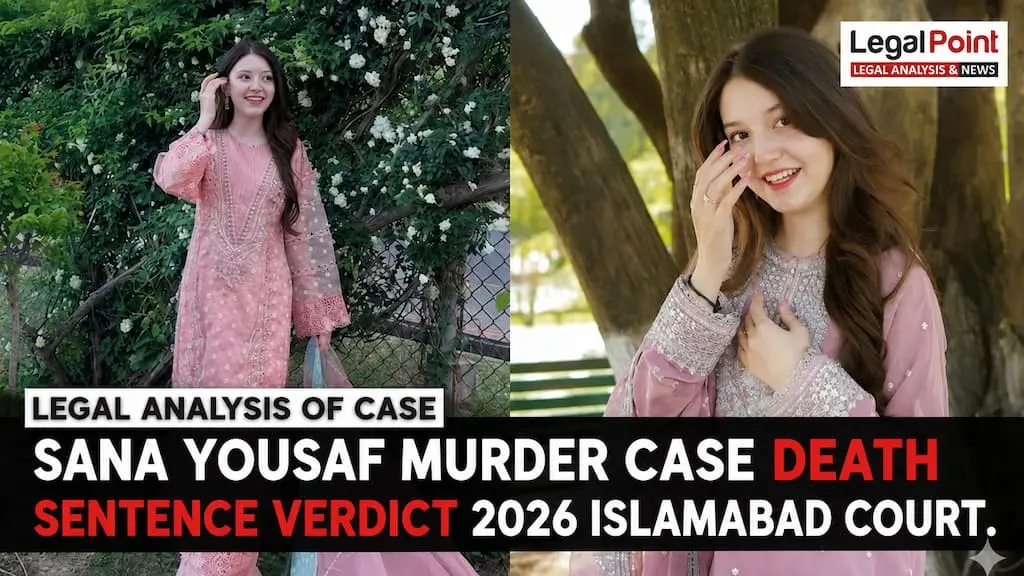
The Sana Yousaf murder case has reached a defining moment in Pakistan’s legal history. On May 19, 2026 — nearly eleven months after 17-year-old TikTok influencer Sana Yousaf was shot dead inside her Islamabad home — an Additional District and Sessions Judge delivered a landmark verdict: death sentence for the convicted killer, Umar Hayat, under Section 302(b) of the Pakistan Penal Code.
This case is no longer just a news story. It is a legal precedent — one that speaks directly to how Pakistan’s criminal justice system handles gender-based violence, digital-age harassment, and the prosecution of high-profile murder cases. This article breaks down 7 critical legal facts every Pakistani citizen should understand about this case.
Table of Contents
The Crime: What Happened in the Sana Yousaf Murder Case?
Sana Yousaf — full name Syed Sana Yusuf Shah — was a 17-year-old social media influencer from Chitral with over a million followers across TikTok and Instagram. She posted content about Chitrali culture, skincare, food, and girls’ education. On June 2, 2025, just hours after uploading birthday videos celebrating her 17th year, she was shot dead at her family home in G-13/1, Islamabad.
Her mother and aunt were present when it happened.
According to police investigations, the perpetrator — Umar Hayat, 22, a fellow TikToker and son of a retired government official — had developed an obsessive fixation on Sana after online interactions. She had rejected his advances repeatedly. On the day of the murder, Hayat rented a Toyota Fortuner, armed himself with a 30-bore pistol, and drove from Faisalabad to Islamabad with a premeditated plan.
When Sana did not come out of her home to meet him, he forced entry. An argument followed. He shot her in front of her family and fled, taking her mobile phone to erase evidence of their prior contact.
The Sana Yousaf murder case triggered immediate nationwide outrage — and also a deeply troubling wave of victim-blaming online, with some users commenting “you reap what you sow” under her final birthday video.
The Arrest: 20 Hours and a Recorded Confession
Islamabad Police arrested Umar Hayat in Faisalabad — approximately 320 km from the crime scene — within 20 hours of the murder. Both the murder weapon and Sana’s stolen iPhone were recovered.
What followed was legally significant: Hayat recorded a confessional statement before a Magistrate under Section 164 of the Code of Criminal Procedure (CrPC), admitting to the killing. Section 164 confessions carry substantial evidentiary weight in Pakistani courts because they are recorded voluntarily before a judicial officer, who must warn the accused of their right to silence before proceeding.
During the subsequent trial, Hayat retracted this confession, denying any prior contact or quarrel with Sana. The court, however, weighed this retraction against eyewitness testimony from Sana’s mother and aunt, digital call records, and the physical evidence — and found the prosecution’s case established beyond reasonable doubt.
Section 302(b) PPC — The Legal Charge in This Case
The Sana Yousaf murder case was prosecuted under Section 302(b) of the Pakistan Penal Code, which governs qatl-i-amd — intentional, deliberate murder.
What Section 302(b) PPC says:
Under this provision, a person convicted of qatl-i-amd (intentional killing) shall be punished with death or life imprisonment as ta’zir (state-imposed discretionary punishment) in cases where the heirs of the victim do not pursue qisas (retributive justice), or where the court invokes its own authority.
The distinction between Section 302(a) and Section 302(b) is critical:
- Section 302(a) — Qisas: The victim’s legal heirs have the right to demand equivalent punishment, accept diyat (blood money), or pardon the killer. If heirs pardon, the accused can walk free.
- Section 302(b) — Ta’zir: The state imposes punishment. Even if the victim’s family forgives the accused or accepts diyat, the state’s sentence continues to operate — unless the court or appellate authority decides otherwise.
By convicting Hayat under Section 302(b), the Islamabad Sessions Court ensured the death sentence cannot be extinguished through a private settlement. This is a direct reflection of Pakistan’s Criminal Law (Amendment) (Offences in the Name or Pretext of Honour) Act, 2016, which was designed to prevent killers from escaping justice through family pardons.
You can review the Pakistan Penal Code provisions through the Ministry of Law and Justice, Government of Pakistan.
The Trial: How the Sana Yousaf Murder Case Was Prosecuted
The formal trial began on September 20, 2025, when Hayat was indicted before the Sessions Court in Islamabad. He pleaded not guilty — meaning the prosecution was required to prove the charge beyond reasonable doubt.
The prosecution’s case rested on four pillars:
Direct eyewitness testimony from Sana’s mother and aunt, who witnessed the shooting inside the family home.
The recovered 30-bore pistol, confirmed as the murder weapon through forensic examination.
Digital evidence including call records and Sana’s recovered iPhone, which contradicted Hayat’s denial of prior contact.
The Section 164 CrPC confession, which Hayat had given voluntarily before a Magistrate following his arrest.
Despite Hayat’s trial retraction, the court found all four pillars consistent and credible. The trial concluded in under twelve months — a remarkably swift outcome for Pakistan’s often-backlogged criminal courts, driven in part by strong evidence, public scrutiny, and institutional accountability.
The Verdict: Death + 10 Years + Rs. 2.5 Million
On May 19, 2026, Additional District and Sessions Judge Muhammad Afzal Majoka announced the verdict in a packed Islamabad courtroom. The sentence had three components:
| Punishment Component | Legal Basis | Details |
|---|---|---|
| Death Sentence | Section 302(b) PPC — qatl-i-amd | Primary sentence for intentional murder |
| 10 Years Imprisonment | Additional charges | To run concurrently with the death sentence |
| Rs. 2.5 Million Compensation | Diyat payable to legal heirs | Approx. USD $7,200 |
Outside the court, Sana’s father stated: “This verdict is not just for me as an individual — it is for the entire society. This is a lesson for all such criminals.”
Her mother, Farzana, added: “The culprit has been given the right punishment.”
The combined sentence reflects the court’s view that this was a planned, aggravated, premeditated murder — one where the perpetrator traveled hundreds of kilometres, armed himself, and forced entry into the victim’s home. There were no mitigating circumstances.
IHC Confirmation: What a Death Sentence Actually Means in Pakistan
Many people assume a death sentence is immediately enforced. In Pakistan, it is not.
Under Section 374 of the CrPC, every death sentence pronounced by a Sessions Court must be confirmed by the High Court before execution. In this case, the sentence is subject to review by the Islamabad High Court (IHC).
The confirmation process works as follows:
The Sessions Court transmits the full trial record to the IHC. The IHC independently reviews all evidence, witnesses, the charge, and the proportionality of the sentence. It may confirm the death penalty, reduce it to life imprisonment, or in rare cases acquit the accused. Either party may also file a regular appeal.
If the IHC confirms, the accused may approach the Supreme Court of Pakistan for further appeal. A mercy petition to the President of Pakistan under Article 45 of the Constitution remains a final constitutional option.
This is not a loophole — it is a safeguard. Capital punishment in Pakistan is not applied lightly, and the multi-stage appellate process is designed to prevent wrongful executions.
Are you or a family member involved in a criminal case?
The attorneys at Legal Point have handled criminal litigation before Sessions Courts, the Islamabad High Court, and the Supreme Court. Our team understands both the prosecution and defence perspectives at every stage of Pakistan’s criminal justice process.
The Legal Gap: What Laws Protect Women in Pakistan Today?
The Sana Yousaf murder case has reignited a critical conversation about whether Pakistan’s legal framework does enough to protect women — particularly those who are publicly visible.
Current legal protections include:
The Pakistan Penal Code (Sections 302, 354, 509) addresses murder, assault, and verbal harassment. The Prevention of Electronic Crimes Act (PECA) 2016, administered by the FIA Cybercrime Wing, criminalises online stalking, harassment, and blackmail. The Criminal Law (Amendment) (Offences in the Name or Pretext of Honour) Act 2016 ensures that honour-related killers cannot be pardoned by complicit family members. The Protection Against Harassment of Women at Workplace Act 2010 covers institutional harassment.
If you or someone you know is facing online harassment, the FIA Cybercrime Wing accepts complaints through their official portal at fia.gov.pk.
Our team at Legal Point also specialises in FIA cybercrime and digital offences and can guide you through the complaint and prosecution process.
Three significant gaps remain:
Pakistan has no standalone anti-stalking law. Obsessive pursuit — physical or digital — frequently goes unaddressed until it escalates. Sana’s case shows how unchecked rejection-based fixation can end in murder.
Under-reporting is widespread. Most women facing harassment never file FIR reports due to fear of social stigma or institutional distrust.
Digital evidence capacity at the police level remains limited. The Sana Yousaf case succeeded partly because of media pressure and institutional urgency — not every victim has that.
Legal reform must be accompanied by enforcement. Laws on paper mean nothing without trained investigators, responsive police, and accessible courts.
Frequently Asked Questions
Q1: Who was convicted in the Sana Yousaf murder case?
Umar Hayat, a 22-year-old TikToker from Faisalabad and son of a retired government official, was convicted of the intentional murder (qatl-i-amd) of 17-year-old Sana Yousaf. He was sentenced to death by an Islamabad Sessions Court on May 19, 2026.
Q2: What is Section 302(b) PPC, and why does it matter in Sana Yousaf murder case?
Section 302(b) of the Pakistan Penal Code provides for death or life imprisonment as ta’zir (state-imposed punishment) for intentional murder. By convicting under this section, the court ensured the sentence cannot be waived through a private pardon or diyat settlement — making it significantly more protective of the public interest.
Q3: Can the death sentence in the Sana Yousaf murder case be reduced?
Yes, it is subject to confirmation by the Islamabad High Court (IHC) under Section 374 CrPC. The IHC may confirm, reduce, or reverse the sentence. The accused may then appeal to the Supreme Court, and ultimately submit a mercy petition to the President of Pakistan.
Q4: Can the victim’s family pardon the killer under Pakistani law?
Under normal circumstances, heirs in a murder case may pardon under qisas or accept diyat. However, since the conviction is under Section 302(b) as ta’zir, the state’s punishment operates independently of any family pardon. The 2016 Anti-Honour Killing Amendment further reinforces this protection.
Q5: What is the compensation amount ordered by the court in Sana Yousaf murder case?
The court ordered Umar Hayat to pay Rs. 2.5 million (approximately USD $7,200) to Sana Yousaf’s legal heirs as diyat compensation — in addition to the death sentence and concurrent 10-year prison term.
Q6: What legal options exist if someone faces rejection-based harassment in Pakistan?
Currently, Pakistan does not have a dedicated anti-stalking law. However, victims can file complaints under PECA 2016 for online harassment, under PPC Section 354 or 509 for physical or verbal harassment, and through the FIA Cybercrime Wing for digital threats. Consulting a criminal law attorney early is strongly advised. Legal Point offers confidential legal consultations for such matters.
Conclusion: A Verdict That Belongs to Every Woman in Pakistan
The Sana Yousaf murder case is no longer just a tragedy. It is a legal precedent — a demonstration that Pakistan’s criminal justice system, when evidence is strong, institutions are held accountable, and public pressure is sustained, can deliver swift and proportionate justice.
But one verdict does not fix a systemic problem. Pakistan still lacks an anti-stalking law. Women still face online harassment with limited legal recourse. Courts are still backlogged. And too many women still face victim-blaming when they speak up.
The IHC confirmation process will determine whether this verdict stands. Legal Point will continue to monitor and report on developments in this case as they unfold.
If you have a criminal matter requiring urgent legal attention — whether as a victim, family member, or accused — contact Legal Point Advocates & Consultants for a professional consultation. Our criminal litigation team operates across Islamabad, Rawalpindi, and Lahore.
Also Read on Legal Point:
- Criminal Litigation Services in Islamabad
- FIA Cybercrime & Digital Offences — Know Your Rights
- Constitutional Petitions & Writ Matters in Pakistan
- Family Law & Women’s Rights in Pakistan
This article is published for legal awareness and public education. It does not constitute formal legal advice. For case-specific guidance, consult a qualified advocate. Legal Point — Discover the Legal.

