


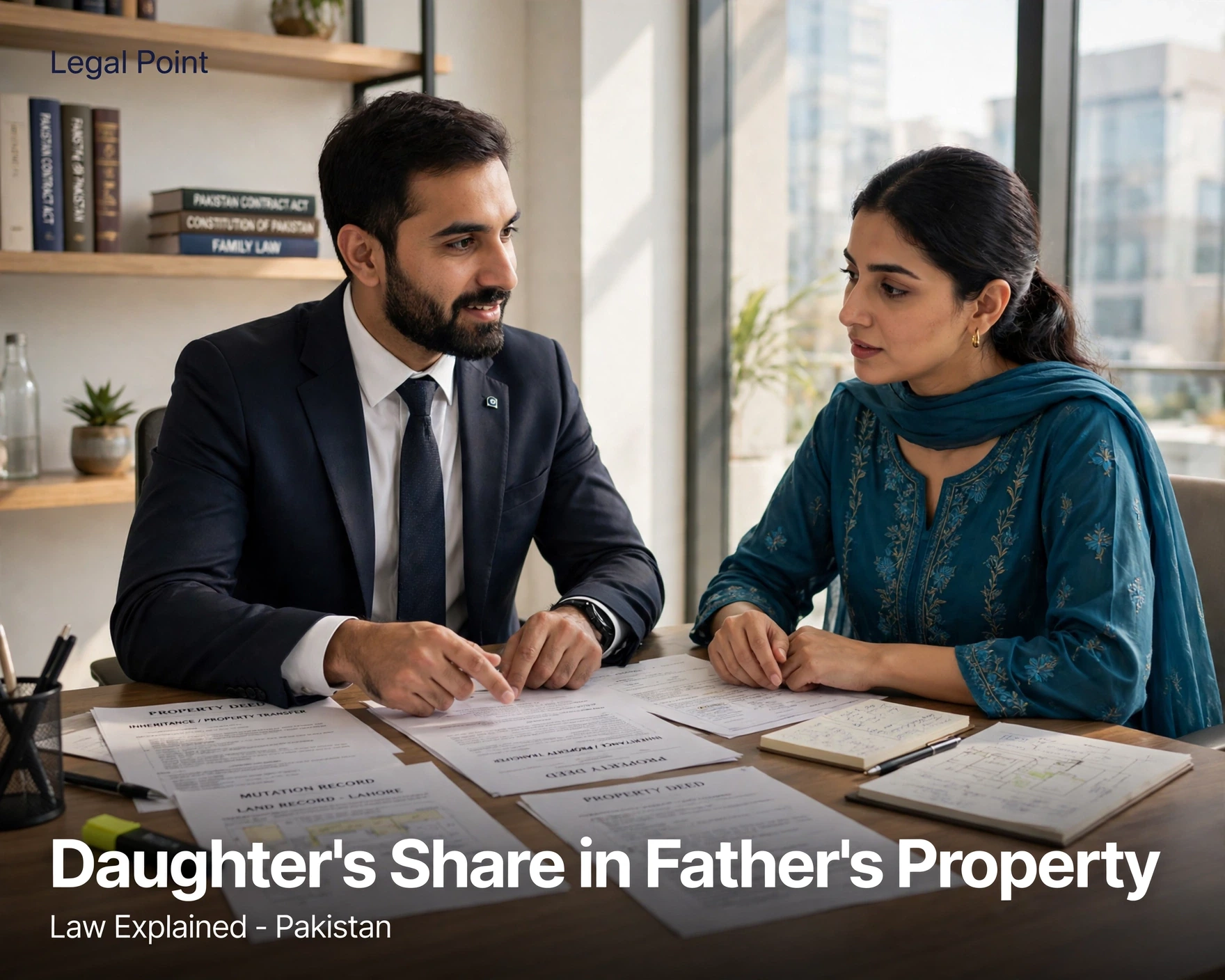
Daughter’s Share in Father’s Property in Pakistan: How Much? What Does the Law Say?
A daughter’s share in her father’s property in Pakistan is a legal right protected under Islamic inheritance principles and Pakistani law. However, many families still face disputes when brothers take control of inherited property, married daughters are excluded from family decisions, or female heirs are pressured to surrender their rightful shares.
One of the most common questions is: How much property does a daughter receive from her father’s estate in Pakistan?
The answer depends on the number of surviving legal heirs. Under Islamic inheritance rules applicable to Muslims, a daughter generally receives half the share of a son when both inherit together. If a deceased father leaves daughters but no sons, one daughter is generally entitled to one-half of the estate, while two or more daughters collectively receive two-thirds, subject to the rights of other eligible heirs.
Pakistani law does not allow brothers, relatives or family customs to automatically deprive a daughter of her inheritance. Section 2 of the West Pakistan Muslim Personal Law (Shariat) Application Act, 1962 provides for the application of Muslim Personal Law in succession matters involving Muslims.
This guide explains a daughter’s inheritance rights, how her share is calculated, whether marriage affects her entitlement, what happens when brothers refuse to distribute property, and which legal remedies may be available.
1. What Are a Daughter’s Inheritance Rights in Pakistan?
A daughter is a legal heir of her deceased father. Her right to inherit does not depend on whether she is married, unmarried, financially independent or living with her husband.
For Muslims in Pakistan, inheritance is generally determined under the applicable Muslim Personal Law (Shariat), subject to relevant legislation and judicial decisions.
A daughter’s inheritance rights include:
- Receiving her legally calculated share of her father’s estate.
- Inheriting alongside her brothers and other eligible family members.
- Claiming her share even if she lives separately from her father’s family.
- Challenging an allegedly fraudulent inheritance mutation or property transfer.
- Seeking legal remedies if relatives unlawfully deprive her of inherited property.
- Participating in a lawful distribution or partition of inherited property.
The right to inherit generally arises immediately upon the death of the property owner. It is not a favour that brothers or other relatives can grant or withdraw.
Important: A daughter does not automatically receive half of the entire property in every family situation. Her exact entitlement must be calculated after identifying all eligible heirs and applying the relevant inheritance rules.
For a broader explanation, read Legal Point’s guide on Property Inheritance Law in Pakistan.
2. How Much Share Does a Daughter Get in Her Father’s Property?
The Quran establishes specific inheritance shares for daughters and other family members. The principal rules concerning children are found in Surah An-Nisa, particularly verses 11 and 12.
For Muslim heirs, the general rules for daughters are as follows.
A. If the Father Leaves One Daughter and No Son
If a deceased father leaves one daughter and no son, the daughter is generally entitled to one-half of the estate as a prescribed Quranic share.
However, the remaining portion must also be distributed according to the rights of other eligible heirs.
For example, the deceased may have left a wife, parents or other relatives who are entitled to inherit. Their shares must be considered before determining the final distribution.
B. If the Father Leaves Two or More Daughters and No Son
If the deceased leaves two or more daughters and no son, the daughters collectively receive two-thirds of the estate as their prescribed share.
For example, if a father leaves two daughters and no sons, the daughters collectively receive two-thirds. Their individual shares are equal, meaning each daughter receives one-third of the estate under this prescribed-share calculation.
The remaining portion is distributed according to the applicable rules and the rights of other eligible heirs.
C. If the Father Leaves Sons and Daughters Together
When sons and daughters inherit together, the general Islamic inheritance rule is:
A son receives twice the share of a daughter.
This means the estate’s residue allocated to the children is divided into units:
- Each son receives two units.
- Each daughter receives one unit.
For example, if there are two sons and one daughter, the children divide their applicable residue into five units. Each son receives two units, while the daughter receives one unit.
This calculation is made after accounting for any fixed shares belonging to other eligible heirs.
3. Practical Examples of Daughter’s Share in Father’s Property
Understanding inheritance through examples makes it easier to see how the rules operate.
The following examples assume that the deceased was a Muslim whose estate is governed by the general Sunni/Hanafi inheritance rules, that the stated heirs are the only relevant heirs, and that all necessary estate expenses and liabilities have been addressed.
Example 1: Father Leaves One Son and One Daughter
Suppose a father dies leaving:
- One son
- One daughter
Assuming there are no other eligible heirs, the estate is divided into three equal units.
| Heir | Share |
|---|---|
| Son | 2/3 |
| Daughter | 1/3 |
| Total | 100% |
If the distributable estate is worth Rs. 90 lakh:
- Son receives Rs. 60 lakh.
- Daughter receives Rs. 30 lakh.
Example 2: Father Leaves Two Sons and One Daughter
Suppose a father leaves:
- Two sons
- One daughter
The children receive five units in total.
| Heir | Share |
|---|---|
| First son | 2/5 |
| Second son | 2/5 |
| Daughter | 1/5 |
| Total | 100% |
If the distributable estate is worth Rs. 1 crore:
- First son receives Rs. 40 lakh.
- Second son receives Rs. 40 lakh.
- Daughter receives Rs. 20 lakh.
Example 3: Father Leaves Two Daughters and No Son
Suppose a father leaves:
- Two daughters
- No son
The daughters collectively receive two-thirds of the estate.
| Heir | Share |
|---|---|
| First daughter | 1/3 |
| Second daughter | 1/3 |
| Remaining estate | 1/3 |
The remaining portion is distributed according to the applicable inheritance rules and the rights of other eligible heirs.
Example 4: Father Leaves a Widow, Two Sons and One Daughter
Suppose a deceased father leaves:
- One widow
- Two sons
- One daughter
Under the general Sunni/Hanafi rules, where the deceased leaves children, the widow receives one-eighth of the estate.
The remaining seven-eighths is distributed among the children in a 2:1 ratio.
| Heir | Share of total estate |
|---|---|
| Widow | 1/8 |
| First son | 7/20 |
| Second son | 7/20 |
| Daughter | 7/40 |
This example demonstrates why the exact family structure matters. The daughter’s share is calculated alongside the rights of the widow and other eligible heirs.
Important: These examples are educational illustrations, not universal calculations. A real inheritance calculation must account for all surviving heirs, the applicable school of Muslim law, debts, valid testamentary dispositions and any other legally relevant circumstances.
4. Does a Married Daughter Have a Right to Her Father’s Property?
Yes. Marriage does not cancel a daughter’s inheritance rights.
A married daughter remains a legal heir of her father. She does not lose her entitlement simply because she has moved to her husband’s home or receives financial support from her husband.
Some families wrongly believe that a daughter should not inherit because:
- She is already married.
- Her husband owns property.
- Her brothers are responsible for maintaining their parents.
- She received wedding gifts or financial assistance.
- She is living outside her father’s home.
These circumstances do not automatically remove her legal inheritance entitlement.
A daughter’s inheritance is her own property. She can hold it, use it, sell it, gift it or otherwise deal with it according to law.
Neither her husband nor her brothers automatically become owners of her inherited property.
5. Can Brothers Deny Their Sister Her Inheritance?
No. Brothers cannot lawfully deprive their sister of her inherited share merely because they are male heirs or manage the family property.
Common situations include:
- Brothers refusing to disclose the deceased father’s property details.
- One brother transferring inherited land into his own name.
- Family members claiming that the daughter has no right after marriage.
- Brothers occupying the entire inherited house or agricultural land.
- A sister being pressured to sign a relinquishment document.
- Relatives claiming that a family custom prevents daughters from inheriting.
These actions must be examined according to the relevant facts and law.
A brother may manage family property or hold physical possession, but possession alone does not automatically make him the exclusive owner of the shares belonging to other legal heirs.
A daughter can seek legal advice about declaration of her share, partition, possession, cancellation of disputed documents or other appropriate relief.
6. Can a Father Give All His Property to His Sons During His Lifetime?
This question requires an important distinction between inheritance and a lifetime transfer.
Inheritance generally takes effect upon a person’s death. A living father remains the owner of his property and may deal with it during his lifetime, subject to applicable law.
However, a lifetime gift is different from inheritance. Its validity depends on the applicable legal requirements and the actual circumstances.
Under Muslim law, a valid gift (Hiba) generally requires:
- A clear declaration of the intention to make a gift.
- Acceptance by the recipient.
- Delivery of possession, subject to the applicable principles and nature of the property.
A transaction described as a gift may be disputed if it was allegedly fabricated, obtained through fraud, made under coercion or never properly completed.
The legal consequences can depend on the nature of the property, documentation, possession, evidence and applicable personal law.
A father should obtain independent legal advice before making substantial lifetime transfers, particularly where the transaction may create a family dispute or involve questions of consent and capacity.
Important: A daughter does not automatically have an inheritance claim to property that was validly transferred by her father during his lifetime. However, she may have grounds to challenge an allegedly fraudulent or legally defective transaction.
7. What If Brothers Transfer Their Father’s Property Without Telling Their Sister?
This is a common inheritance dispute in Pakistan.
For example, a father dies leaving two sons and two daughters. The sons obtain an inheritance mutation or transfer the property into their names without properly identifying or notifying their sisters.
The sisters later discover that the property has been transferred or that their names are missing from the revenue record.
A mutation entry should not be treated as an automatic legal determination that an omitted daughter’s inheritance rights have disappeared.
A daughter may need to examine:
- The original ownership documents.
- The deceased father’s property record.
- Death certificate.
- Family Registration Certificate (FRC).
- Inheritance mutation.
- Details of all legal heirs.
- Any gift deed, sale deed or relinquishment document.
- Evidence showing whether she was informed or participated in the transaction.
Depending on the circumstances, she may seek a declaration of her inheritance rights, challenge a disputed mutation or document, and request partition or possession through the competent forum.
The appropriate remedy depends on the property’s location, the type of record, the parties involved and the evidence available.
8. What Does Section 498-A PPC Say About Depriving Women of Inheritance?
Section 498-A of the Pakistan Penal Code, 1860 specifically addresses the deprivation of women from inheriting property through deceitful or illegal means.
The provision makes it an offence to deprive a woman of movable or immovable property at the time of opening of succession through deceitful or illegal means.
The prescribed punishment is:
- Imprisonment for a term that may extend to ten years but cannot be less than five years; or
- A fine of one million rupees; or
- Both.
This provision is particularly important where relatives use deception, illegal documents or other unlawful methods to prevent a female heir from receiving her inheritance.
For example, a daughter may face an inheritance dispute where:
- Her brothers deliberately conceal the father’s death or property details.
- Her signature is allegedly obtained through deception.
- A fraudulent document is used to exclude her.
- Relatives use unlawful means to transfer inherited property without recognising her rights.
Whether Section 498-A applies depends on the evidence and legal ingredients of the offence. Not every inheritance disagreement automatically amounts to a criminal offence.
A criminal complaint under Section 498-A and a civil claim for declaration, partition or possession are distinct legal processes. Depending on the circumstances, more than one remedy may be relevant.
The official Pakistan Code should be consulted for the statutory text.
9. What If a Daughter Is Forced to Give Up Her Inheritance Share?
In some families, daughters are pressured to surrender their shares in favour of their brothers or other relatives.
This may happen through:
- Emotional pressure.
- Threats or intimidation.
- False promises of future financial support.
- Misrepresentation of the actual inheritance share.
- Documents signed without proper explanation.
- Alleged relinquishment deeds or family settlements.
A document signed by a daughter should not automatically be treated as conclusive proof that her inheritance rights were voluntarily surrendered.
The legal validity of a transaction depends on its nature, the circumstances in which it was executed, the daughter’s knowledge of her actual entitlement, her consent, the applicable formalities and available evidence.
In a judgment concerning women’s inheritance rights, the Federal Constitutional Court emphasised careful scrutiny of transactions that may deprive female heirs of their shares. Suspicious circumstances, disproportionate terms and the absence of informed and voluntary consent can be important when assessing the validity of such transactions.
The Supreme Court has also issued important directions in November 2026 concerning the protection of legal heirs during inheritance mutations and property transfers.
A daughter who believes she was pressured or deceived should obtain a legal review of the original documents before accepting that her rights have been permanently surrendered.
10. Can a Daughter Claim Her Father’s Property After Many Years?
A daughter may still have a legal remedy even if she discovers the exclusion from her father’s inheritance years after his death.
However, limitation law can become relevant, and the outcome depends on the nature of the claim, the date she learned of the denial, the documents involved and the evidence.
In November 2026, the Supreme Court of Pakistan clarified important principles concerning limitation in inheritance disputes.
The Court explained that, in a suit for declaration of an inherited share governed by Article 120 of the Limitation Act, 1908, the six-year period is connected to the date an overt act denying the heir’s title becomes known to that heir.
Where an heir seeks to avoid an instrument to which they were personally a party, Article 91 and its applicable limitation period may become relevant.
The Court also distinguished a mere incorrect mutation or passage of time from an actual denial of an heir’s title.
This does not mean that every inheritance claim can be filed at any time without considering limitation. The facts, nature of the relief, date of knowledge and applicable legal provisions must be examined.
Practical advice: If you discover that your name or share is missing from your father’s property record, consult a lawyer promptly. Do not assume that the claim is automatically time-barred or automatically maintainable.
11. How Can a Daughter Claim Her Father’s Property in Pakistan?
A daughter whose inheritance rights have been denied may need to follow a legal process to establish and obtain her share.
The appropriate procedure depends on the type of property, its location, the existence of disputes and the documents available.
Step 1: Obtain the Father’s Death Certificate
The death certificate is an important document for establishing the death of the property owner and proceeding with inheritance-related documentation.
Step 2: Identify All Legal Heirs
Prepare a complete list of the deceased father’s surviving legal heirs.
This may include:
- Widow.
- Sons.
- Daughters.
- Father and mother, if alive at the time of death.
- Other eligible heirs, depending on the circumstances and applicable inheritance rules.
An accurate list is essential because excluding an eligible heir can lead to an incorrect distribution.
Step 3: Collect Family and Property Documents
Gather the documents needed to identify the deceased, the heirs and the property.
These may include:
- CNIC copies of legal heirs.
- NADRA Family Registration Certificate.
- Death certificate.
- Registry or ownership documents.
- Fard or relevant revenue record.
- Existing inheritance mutation.
- Property allotment documents.
- Details of bank accounts or other movable assets.
Step 4: Obtain the Relevant Succession Documentation
The documentation depends on the assets involved.
A Succession Certificate is generally used for movable assets, such as bank balances and securities, while a Letter of Administration is generally relevant to immovable property.
The applicable procedure may involve NADRA or a competent court, depending on the law, the nature of the assets and whether an objection or dispute exists.
Read Legal Point’s guides:
- NADRA Succession Certificate Required Documents
- How to Apply for a Succession Certificate in Pakistan
Step 5: Apply for Inheritance Mutation Where Applicable
For land and other revenue-recorded property, the relevant inheritance mutation process may be necessary.
All eligible heirs should be properly identified. Their shares should be calculated according to the applicable inheritance rules.
A daughter should carefully review the mutation record to confirm that her entitlement has not been omitted or incorrectly recorded.
Step 6: Seek Partition or Possession
If the property is jointly inherited and the heirs cannot agree on its distribution, a daughter may need to seek partition or another appropriate civil remedy.
Depending on the property and jurisdiction, the available relief may include:
- Declaration of legal inheritance rights.
- Partition of jointly inherited property.
- Separate possession of the lawful share.
- Cancellation or challenge of an allegedly fraudulent document.
- Injunction against an unlawful transfer.
- Other appropriate relief based on the facts.
Step 7: Take Legal Action if the Share Is Denied
If relatives refuse to recognise the daughter’s share or the property has allegedly been transferred unlawfully, she may consider approaching the competent court or relevant authority.
A lawyer can review the documents, identify the appropriate legal forum and determine whether civil proceedings, criminal proceedings or another remedy may be suitable.
12. What Documents Are Required for a Daughter to Claim Inheritance?
The documents required depend on the nature of the property and the legal procedure.
| Document | Why It May Be Required |
|---|---|
| Father’s death certificate | Confirms the death of the property owner |
| Daughter’s CNIC | Identifies the claimant |
| Family Registration Certificate | Helps identify family relationships |
| CNIC copies of other heirs | Helps establish the list of legal heirs |
| Property registry or ownership record | Establishes the deceased’s ownership |
| Fard or mutation record | Shows relevant land and revenue entries |
| Succession Certificate or Letter of Administration | Relevant to administration or transfer of estate assets |
| Gift or relinquishment documents | Helps assess disputed transfers |
| Previous court orders | Relevant if earlier litigation exists |
It is advisable to preserve original documents and obtain certified copies where required.
If any document appears suspicious, do not alter it. Have it examined by a qualified lawyer.
13. What Did the Supreme Court Say About Women’s Inheritance Rights in 2026?
Recent judicial developments have reinforced the importance of protecting women’s inheritance rights in Pakistan.
Supreme Court – July 2026
The Supreme Court reaffirmed that inheritance is a legal and Sharia-based right that devolves upon eligible heirs, including women, immediately upon the death of the property owner.
The Court emphasised that inheritance rights cannot be defeated merely through family pressure, private arrangements, customs or questionable revenue entries.
This is particularly important for daughters who are excluded from property distribution because their brothers claim exclusive control over the family estate.
Federal Constitutional Court – June 2026
The Federal Constitutional Court addressed the need for careful examination of transactions that may affect women’s property and inheritance rights.
It emphasised the importance of establishing informed and voluntary consent, particularly where a transaction appears one-sided or prejudicial to a female heir.
This is relevant to cases involving alleged forced relinquishment, suspicious gifts and disputed settlements.
Supreme Court – November 2026
In a significant judgment reported on November 15, 2026, the Supreme Court clarified limitation principles concerning inheritance claims.
The Court also directed safeguards for identifying and notifying all legal heirs during inheritance mutations and certain property transfers.
The judgment emphasised the importance of proper identification, written notices and verification of an heir’s understanding of their actual share when dealing with inherited property.
These developments strengthen the legal framework for protecting daughters and other female heirs. However, the result of an individual case still depends on its facts, evidence and applicable law.
14. How Legal Point Can Help With Daughter’s Inheritance Disputes
Inheritance disputes can become complicated when brothers refuse to distribute property, documents are disputed, a daughter is excluded from a mutation or family members pressure her to surrender her legal entitlement.
Legal Point – Advocates & Consultants provides legal assistance in property, civil and family-related matters in Islamabad, Rawalpindi and other areas of Pakistan, depending on the nature and jurisdiction of the case.
Under the guidance of Advocate M. Javed Iqbal, clients can seek legal assistance with matters such as:
- Understanding a daughter’s legal share in her father’s property.
- Reviewing inheritance calculations and family records.
- Examining property ownership and mutation documents.
- Preparing legal claims concerning inheritance rights.
- Challenging disputed or allegedly fraudulent property transfers.
- Seeking partition and possession where legally appropriate.
- Understanding remedies under Section 498-A PPC.
- Resolving property disputes involving brothers and sisters.
Every inheritance dispute requires a review of the deceased’s family structure, property documents, applicable personal law and relevant court decisions.
Contact Legal Point – Advocates & Consultants
- Website: https://legalpoint.pk/
- Phone: +92 333 7703712
- Facebook: https://www.facebook.com/LegalPointOfficial/
- Location: G-13/1, Islamabad
Find Legal Point on Google Maps
If your brothers have refused to recognise your inheritance share, or you have discovered a suspicious property transfer, obtain legal advice before signing any settlement or relinquishment document.
15. Frequently Asked Questions About a Daughter’s Share in Father’s Property
1. How much property does a daughter get from her father in Pakistan?
Under the general Islamic inheritance rules applicable to Muslims, one daughter with no son is generally entitled to one-half of the estate, while two or more daughters with no son collectively receive two-thirds. When sons and daughters inherit together, each son receives twice the share of a daughter from the children’s applicable residue. Other heirs can affect the final calculation.
2. Does a married daughter have a right to her father’s property?
Yes. Marriage does not remove a daughter’s inheritance rights. She remains entitled to her legally calculated share regardless of whether she lives with her husband or receives financial support from him.
3. Can brothers take all of their father’s property?
No. Brothers cannot lawfully take the shares belonging to their sisters or other eligible heirs merely because they control the property or manage the family estate. An affected sister may seek appropriate legal remedies.
4. Can a daughter claim inheritance if her brothers have transferred the property?
She may be able to challenge an allegedly fraudulent or unlawful transfer and seek recognition of her inheritance rights. The appropriate remedy depends on the documents, transaction, possession, limitation and facts of the case.
5. What is Section 498-A PPC in Pakistan?
Section 498-A PPC criminalises depriving a woman of movable or immovable property at the time succession opens through deceitful or illegal means. It prescribes imprisonment of five to ten years, a fine of one million rupees, or both.
6. Can a father give his property to his sons during his lifetime?
A father may deal with his property during his lifetime, subject to applicable law. A genuine and legally valid lifetime gift is different from inheritance. If the transaction is allegedly fraudulent, coerced or legally defective, it may be challenged on appropriate grounds.
7. Can a daughter claim her inheritance after ten or twenty years?
A claim may remain legally possible, but limitation law and the date on which the daughter learned of an overt denial of her rights can be important. The Supreme Court clarified these issues in November 2026. Each case needs individual legal assessment.
8. Can a daughter refuse to give her inheritance share to her brothers?
Yes. A daughter is not legally required to surrender her inheritance merely because her brothers request it. Any proposed transfer or relinquishment should be voluntary, informed and legally valid.
9. Can a daughter sell her inherited property without her brothers’ permission?
A daughter can generally deal with her own legally established share. However, if the property is jointly owned or undivided, the method of transfer and the practical consequences depend on the nature of the property and applicable law.
10. Does a daughter inherit agricultural land in Pakistan?
Yes. Muslim personal law governs succession matters for Muslims, including relevant agricultural property. A daughter cannot be excluded merely because the property is agricultural land or because of a contrary family custom.
11. Is an inheritance mutation enough to prove ownership?
A mutation is an important revenue record, but it should not automatically be treated as a final determination of title in every dispute. Its legal effect depends on the underlying transaction, evidence and applicable law.
12. What should a daughter do if her family refuses to give her inheritance?
She should collect the relevant family and property documents, obtain a copy of the inheritance mutation, identify all legal heirs and consult a qualified lawyer. Depending on the facts, she may seek declaration, partition, possession, cancellation of disputed documents or another appropriate remedy.
Official Legal References
For readers who want to examine the relevant laws and judicial developments, the following sources are useful:
- West Pakistan Muslim Personal Law (Shariat) Application Act, 1962 – Section 2:
https://pakistancode.gov.pk/pdffiles/administrator43496aa4c309b625076eccef03abef93.pdf - Pakistan Penal Code, 1860 – Section 498-A:
https://pakistancode.gov.pk/pdffiles/administratoracbdabf2b79c8956d6ea4804fcceb92d.pdf - Federal Constitutional Court – C.P.L.A. 143-Q of 2025:
https://www.fccp.gov.pk/ - Supreme Court inheritance judgment reporting – November 2026:
https://www.dawn.com/news/2044595/supreme-court-settles-conflicting-rulings-on-inheritance-rights - Supreme Court judgment reporting – July 2026:
https://pass.dawn.com/news/2012294/womens-inheritance-rights-enshrined-in-sharia-supreme-court-holds
Legal Disclaimer: This article is for general educational and informational purposes. It does not constitute individual legal advice. Inheritance calculations may differ according to the applicable personal law, sect, family structure, surviving heirs, liabilities, valid gifts, wills and other legally relevant circumstances. Consult a qualified advocate before taking action in an inheritance dispute.

