


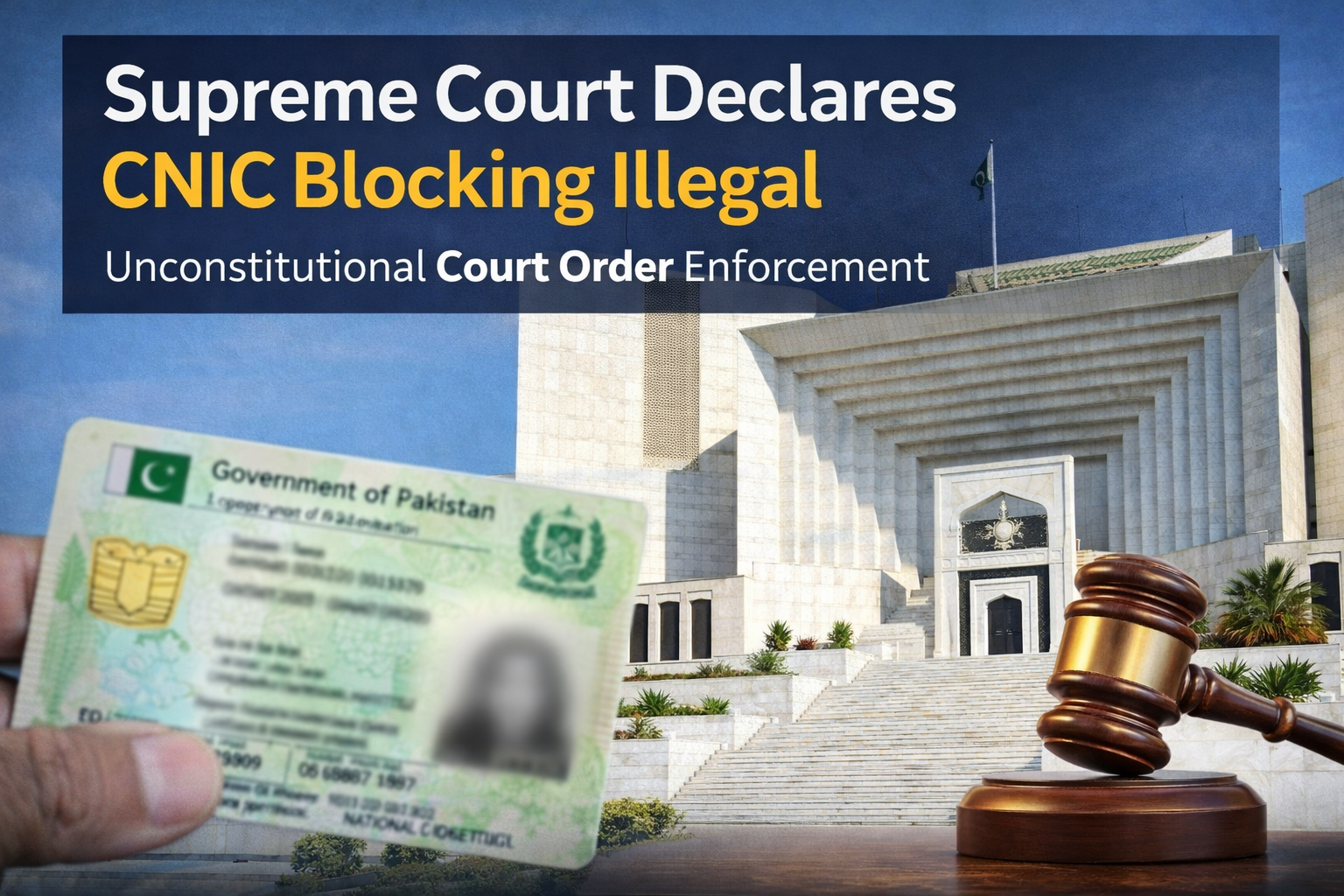

CNIC BLOCKING CASE: In a landmark constitutional development, the Supreme Court of Pakistan has ruled that blocking a citizen’s Computerized National Identity Card (CNIC) to enforce compliance with a court order is unlawful and unconstitutional.
The judgment, authored by Justice Munib Akhtar, clearly states that a CNIC is not a luxury or administrative privilege — it is an essential legal identity document necessary for modern life. Suspending or blocking it effectively deprives a citizen of fundamental rights guaranteed under the Constitution of Pakistan.
This decision sets an important precedent regarding the limits of judicial enforcement powers and the protection of civil liberties.
Table of Contents
Background of the Case
The ruling emerged from a case where a citizen’s CNIC was blocked allegedly for non-compliance with a court decree. The matter eventually reached the Supreme Court, where the legality of such enforcement measures was examined.
The Court observed that while courts possess authority to ensure execution of their judgments, enforcement mechanisms must remain within constitutional and statutory boundaries.
The Supreme Court set aside the decision of the Sindh High Court, which had upheld the CNIC blocking action.
Key Legal Principle Established by the Supreme Court
The Court raised a fundamental constitutional question:
If non-compliance with a court order justifies blocking a CNIC, could the State also suspend electricity, water, or other essential utilities?
The Court firmly rejected such reasoning.
It clarified that:
- A CNIC represents a citizen’s legal existence.
- It is required for banking transactions, travel, employment, property ownership, voting rights, SIM registration, and access to public services.
- Blocking it as a coercive measure amounts to deprivation of fundamental rights.
The Court held that enforcement of court orders must rely on legally recognized procedures such as:
- Contempt of court proceedings
- Fines
- Attachment of property
- Other lawful execution mechanisms
But suspending a citizen’s identity document without explicit statutory authority is unconstitutional.
Why This Judgment Is Constitutionally Significant
This decision reinforces protection of:
- Right to life and dignity (Article 9 & 14 of the Constitution)
- Due process of law
- Protection from arbitrary executive action
- Limits on discretionary powers of public authorities
The Supreme Court emphasized that NADRA or any other institution cannot use CNIC blocking as a punitive tool unless there is a clear legal provision authorizing such action.
This ruling strengthens judicial accountability while simultaneously protecting citizens from excessive enforcement practices.
Impact on NADRA and Government Authorities
Following this decision:
- NADRA cannot block CNICs merely for enforcement of civil court decrees.
- Execution courts must use legally prescribed remedies.
- Administrative authorities must ensure constitutional compliance before restricting civil identity rights.
This judgment will guide future litigation concerning:
- Judicial powers of execution
- NADRA authority limits
- Constitutional safeguards in enforcement proceedings
- Abuse of discretionary state power
What to Do If Your CNIC Has Been Blocked
If your CNIC has been blocked due to a court-related matter or government action:
- Verify the legal basis of blocking.
- Obtain a written explanation from the concerned authority.
- File an appropriate constitutional petition if fundamental rights are violated.
- Seek legal consultation immediately.
Timely legal action is essential to restore identity rights and prevent further complications in banking, travel, employment, and property matters.
Read our next article on Guide To Unblock your CNIC.
For More Detail watch : https://youtu.be/CNIC Unblock
Professional Legal Assistance
At Legal Point, we provide:
- Legal consultation regarding CNIC blocking issues
- Constitutional petitions before High Courts
- Advisory on enforcement proceedings
- Guidance on fundamental rights protection
- NADRA-related legal compliance matters
If your CNIC has been suspended or you are facing enforcement-related legal issues, contact us through WhatsApp for professional legal guidance.
Visit: www.legalpoint.pk
Final Judgments on Supreme Court of Pakistan Ruling
The Supreme Court’s ruling marks a crucial constitutional milestone. It clearly establishes that enforcement of court orders cannot come at the cost of a citizen’s legal identity and fundamental rights.
While judicial authority must remain effective, it cannot override constitutional protections.
This judgment ensures that rule of law remains balanced — strong in enforcement, but restrained within constitutional limits.
Frequently Asked Questions (FAQs)
1. Can a court block a CNIC in Pakistan?
No. The Supreme Court of Pakistan has ruled that blocking a CNIC to enforce a court order is unconstitutional unless there is clear legal authority.
2. Why is CNIC blocking considered illegal?
Because a CNIC is essential for banking, travel, employment, voting, and property rights. Blocking it deprives a citizen of fundamental constitutional rights.
3. Can NADRA block a CNIC on court instructions?
Only if there is explicit statutory backing. NADRA cannot block CNICs merely as a coercive enforcement tool.
4. What legal remedies are available for court order enforcement?
Courts may use contempt proceedings, fines, property attachment, or other lawful execution methods.
5. What should I do if my CNIC is blocked?
You should immediately seek legal advice and consider filing a constitutional petition in the relevant High Court.