


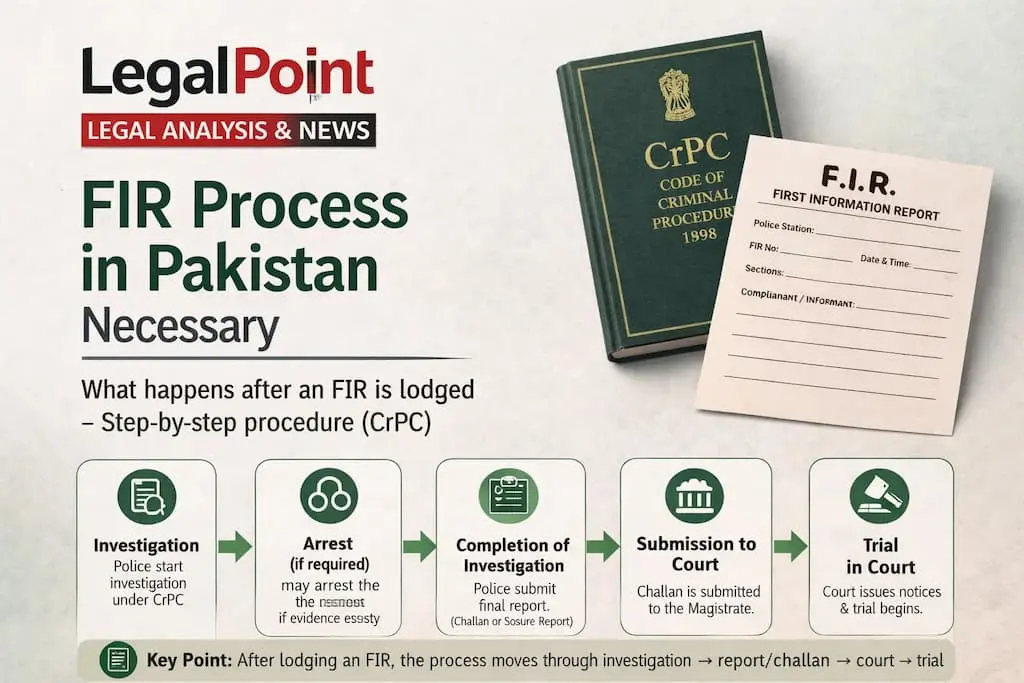
Registering an FIR (First Information Report) under Section 154 CrPC is the starting point of the FIR process in Pakistan. After filing, police investigate the offense, collect evidence, and may arrest the accused (or grant bail). They then submit a Challan under Section 173 CrPC to the court, which takes cognizance, frames charges, and holds a trial. A final judgment (acquittal or conviction) follows, with options to appeal.
Islamabad Police emphasize that “FIR is the basic right of every complainant… and it is the duty of Police to register it promptly” . Recent Supreme Court rulings underline that unjustified delays or refusals to register FIRs violate this duty.
Introdution to FIR Process
Filing/lodging an FIR is the First step in FIR Process :
Filing an FIR under Section 154 of the Criminal Procedure Code (CrPC), 1898 is the first step in FIR Process. The law requires police to record any information alleging a cognizable offense.
Islamabad Police clearly states that “FIR is the basic right of every complainant… and it is the duty of Police to register it promptly”. In other words, once you report a crime, police must enter your complaint and begin action. An FIR itself does not determine guilt – it simply sets the legal process in motion.
Steps in FIR Process after lodging FIR

Police Investigation Begins (FIR Process in Pakistan)
After an FIR is lodged, the police’s Investigating Officer (IO) immediately begins gathering evidence. This typically involves visiting and photographing the crime scene, collecting physical or forensic evidence (e.g. fingerprints, DNA), and medically examining the victim and any suspects. The IO will record detailed witness statements (under Section 161 CrPC) and may search the accused’s premises if needed.
All these steps must be done promptly and without undue delay. In fact, the Supreme Court has held that registering and investigating an FIR is a mandatory duty of the police and no reason justifies wilful delay or refusal. As one legal analysis notes, “an investigation normally commences once an FIR is lodged,” and it covers “everything from the collection of evidence, recording of statements to the submission of the police report”.
Arrest, Remand & Bail
During the investigation, if there is reason to believe the accused committed the crime, the police can make an arrest without a warrant (for cognizable offenses). The accused must then be produced before a magistrate within 24 hours. The court will decide on pre-trial custody: it may remand the accused to police or judicial custody if more investigation is needed, or release them on bail. For bailable offenses, law requires police to grant bail with surety. For non-bailable offenses, bail is a matter of the court’s discretion.
The court generally grants bail if it trusts the accused will not flee or threaten evidence. Our Bail Assistance page can help clients secure bail quickly in Islamabad. (Consulting a lawyer promptly is key to avoid unnecessary custody.)
Submission of Police Report (Challan)
Once the IO completes the investigation (usually within 14–90 days), they must file a Challan under Section 173 CrPC. The challan is the official police report to the court. It contains the collected evidence (documents, photos, forensic reports), summaries of witness statements, and any recoveries (e.g. weapons, stolen goods) tied to the case. The IO also typically states an opinion on whether the evidence shows a prima facie case.
Filing the challan formally informs the court of the prosecution’s case. As one source explains, the investigation concludes when the IO decides there “is a case to place before the [court] for trial” and then proceeds with “filing of a challan under Section 173 CrPC”. If the challan shows sufficient evidence, the court proceeds to trial. If evidence is lacking, the IO may note “no case,” and the magistrate can discharge the accused.
Court Takes Cognizance and Frames Charges
With the challan before it, the magistrate reviews the evidence. If the court finds a prima facie case, it takes cognizance of the offense (officially accepting the case) and issues a summons or warrant to the accused. The accused is then called to court and formally informed of the charges in an “FIR-based case.” The court asks the accused to plead guilty or not guilty. This framing of charges marks the start of the trial. (If the magistrate finds no case, the accused will be discharged at this point.)
Trial (Evidence & Cross-Examination)
During the trial, the prosecution presents its witnesses one by one. These typically include the victim, eyewitnesses, and any expert witnesses. Each prosecution witness gives testimony about what they saw or know. Your defense lawyer can then cross-examine each witness, questioning them on inconsistencies, biases, or gaps in their testimony.
Next, under Section 342 CrPC, the accused has a chance to make a statement on the allegations (though they cannot be forced to incriminate themselves). If the accused pleads not guilty, they may also present defense witnesses and evidence supporting their innocence. Once all evidence is heard, both sides make final arguments. The judge then considers the full trial record before giving a judgment.
Judgment and Appeal
At the end of trial, the court delivers a judgment:
- Acquittal: If the judge finds that the prosecution has not proved guilt beyond reasonable doubt, the accused is acquitted. The court will order release if the accused is still in custody.
- Conviction: If the evidence establishes guilt, the accused is convicted. The court then announces the sentence, which may include a fine, imprisonment, or both.
Both sides have the right to appeal. The prosecution can appeal against a low sentence or an acquittal, while the defense can appeal a conviction or a harsh sentence. Appeals in criminal cases go to the Islamabad High Court and (if necessary) the Supreme Court, following the CrPC’s appellate procedure.
Private Criminal Complaint vs. FIR
If Islamabad police unlawfully refuse to register your FIR, you have an alternative: file a private criminal complaint directly before a magistrate. In a private complaint, you (the complainant) petition the court with evidence, and the magistrate can order the police to investigate. NMK Legal explains that private complaints are particularly useful “when the police fail to register an FIR or conduct an impartial investigation”. Note that a private complaint requires you to provide evidence upfront (witness statements, documents, etc.). For most cases, lodging an FIR with the police is simpler, but knowing you can go to court can pressure police to register your FIR promptly. (Internal link: see our Criminal Law Services for help with FIRs or private complaints.)
Remedies if Police Refuse FIR
If the police still delay or refuse your FIR, you can escalate the matter. You may file an application under Sections 22-A/22-B CrPC with a Session Judge or Judicial Magistrate, asking them to direct the police to register the FIR. You can also directly approach the Islamabad High Court by filing a writ petition under Article 199 of the Constitution.
The Supreme Court has firmly held that denying or unduly delaying an FIR is unlawful and violates citizens’ rights. In practice, it is wise to consult a lawyer immediately if your FIR is stalled.
FIR registration delays, refusals can’t be justified, rules SC
Quashing or Removing a False FIR
If you are acquitted or the case against you is quashed, you can seek removal of the FIR from police records. As Mughal Barristers notes, “an FIR only starts an investigation. It does not prove guilt”. Once you have a certified court order of acquittal or quashment, you apply to the police or prosecution to update the case status.
If the police resist clearing your record, you may file a writ petition in the High Court. Acting early to clear your name is important.
Read our related guide : False FIR -Remedies, Quash FIR, Bail & Punish the False Accuser
Practical Tips
- Document everything: Immediately photograph or record evidence (injuries, property damage, etc.) and give copies to the police.
- Keep calm and persistent: Follow up politely with police. If there’s an error in your FIR, insist on having it corrected.
- Use technology: For minor complaints, consider filing the FIR online via the Islamabad Police portal.
- Consult a lawyer early: An attorney can ensure your FIR is properly drafted and guide you through each stage (see our Criminal Law Services).
If you’re facing hurdles with your FIR or the police process, contact our Islamabad criminal law experts now. We specialize in criminal cases and can help you navigate the FIR process in Pakistan step by step.
Frequently Asked Questions (FAQs)
Q1: What is Section 154 CrPC and why is it important in the FIR process?
Section 154 CrPC is the provision that mandates police to record any information about a cognizable offence. In simple terms, it requires an officer in charge of a police station to reduce any such information to writing and have the informant sign it. This is crucial because it officially launches the criminal process. Islamabad Police even calls FIR registration “the basic right of every complainant”.
Q2: What happens after an FIR is registered in Islamabad?
Once an FIR is registered, the police investigate the allegations – visiting the scene, collecting evidence, and recording witness statements. If investigators find sufficient evidence, they complete the investigation and submit a challan (police report) to the court under Section 173 CrPC. The court then frames charges and conducts a trial, eventually leading to a judgment.
Q3: Can the police arrest immediately after I file an FIR?
Police have the power to arrest a suspect of a cognizable offense without a warrant. So if you name an accused and the offense is serious, the police can make an arrest right after the FIR. Otherwise, they may summon the accused to court. In any case, bail is available: for bailable offences the police must grant bail, and for non-bailable offences you can apply to the court for bail on your first appearance.
Q4: What is a challan and when is it submitted?
A challan is the police report filed in court under Section 173 CrPC after investigation. It summarizes all the evidence gathered (documents, recoveries, witness statements, etc.). The challan is submitted to the magistrate once the police finish investigating (usually within 14–90 days). It formally tells the court the outcome of the investigation and whether the police think there is a case to answer.
Q5: What if police refuse to register my FIR?
If police refuse or delay your FIR, you can file a complaint under Section 22-A/22-B CrPC asking a judge to order the FIR’s registration. You can also petition the Islamabad High Court (Article 199 writ) to compel the FIR. The Supreme Court has made clear that refusing to register a valid FIR is a violation of law. You should consult a lawyer immediately if this happens.
Q6: How can I remove a false FIR from the records?
If you are acquitted or your case is quashed, you should obtain the court’s certified order of acquittal/quash. Then request the police or prosecutor to update their records. Courts have held that an FIR “only starts an investigation. It does not prove guilt”. If authorities don’t cooperate, you can file a writ petition in High Court to have the FIR expunged. Our FIR Quash & Appeal service can guide you through this process.
Watch our video for False FIR in Pakistan? Act Now: Bail, Quash & Punish False Accuser | LegalPoint.pk
Q7: What’s the difference between an FIR and a private criminal complaint?
An FIR is filed at a police station to trigger a police investigation. A private criminal complaint is filed directly in court if the police won’t register your FIR. In a private complaint, the magistrate examines your evidence and can order the police to act. Private complaints are a remedy when police inaction stalls justice, but they require you to present strong evidence upfront.
Q8: How long does the FIR investigation take?
Legally, police should complete a normal investigation within 14 days for summary offences and up to 90 days for others (extensions require court approval). In complex cases, investigators may need more time with court orders. If investigation drags on unjustifiably, you can ask a court to direct the police to expedite their work.

